


Page 539 - AR PAM 2024 HIGHRES_4 Direksi
P. 539
Selain limbah B3, Perusahaan juga menghasilkan jenis limbah lain   In addition to B3 waste, the Company also produces other types
                  seperti sampah dari kegiatan domestik perkantoran dan sampah residu.   of waste such as waste from domestic office activities and residual
                  Dalam pengelolaan sampah, PAM JAYA mengikuti pedoman yang   waste. PAM JAYA’s waste management follows the guidelines in the
                  tertuang dalam Peraturan Gubernur No. 102 Tahun 2021 tentang   Governor Regulation No. 102 of 2021 concerning Waste Management
                  Kewajiban Pengelolaan Sampah di Kawasan Perusahaan. PAM JAYA   Obligations in Company Areas. PAM JAYA also provides Sorted
                  juga menyediakan Tempat Sampah Terpilah (4 pilah) serta Tempat   Waste Bins (4 types) and a Temporary Waste Storage Facilities
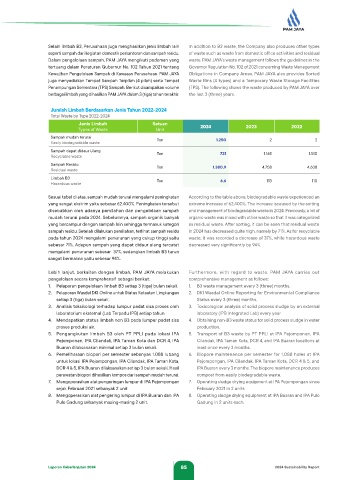
                  Penampungan Sementara (TPS) Sampah. Berikut disampaikan volume   (TPS). The following shows the waste produced by PAM JAYA over
                  berbagai limbah yang dihasilkan PAM JAYA dalam 3 (tiga) tahun terakhir.  the last 3 (three) years.

                   Jumlah Limbah Berdasarkan Jenis Tahun 2022-2024
                   Total Waste by Type 2022-2024
                             Jenis Limbah              Satuan
                                                                       202
                                                                          4
                            Types of Waste              Unit           2024            2023            2022
                   Sampah mudah terurai                 Ton                  1.250              2               2
                   Easily biodegradable waste
                   Sampah dapat didaur Ulang            Ton                   731             1.168           1.140
                   Recyclable waste
                   Sampah Residu                        Ton                 1.380,9          4.758           4.608
                   Residual waste
                   Limbah B3                            Ton                   6,6              113             110
                   Hazardous waste
                  Sesuai tabel di atas, sampah mudah terurai mengalami peningkatan   According to the table above, biodegradable waste experienced an
                  yang sangat ekstrim yaitu sebesar 62.400%. Peningkatan tersebut   extreme increase of 62,400%. The increase iscaused by the sorting
                  disebabkan oleh adanya pemilahan dan pengelolaan sampah   and management of biodegradable waste in 2024. Previously, a lot of
                  mudah terurai pada 2024. Sebelumnya, sampah organik banyak   organic waste was mixed with other waste so that it was categorized
                  yang bercampur dengan sampah lain sehingga termasuk kategori   as residual waste. After sorting, it can be seen that residual waste
                  sampah residu. Setelah dilakukan pemilahan, terlihat sampah residu   in 2024 has decreased quite high, namely by 71%. As for recyclable
                  pada tahun 2024 mengalami penurunan yang cukup tinggi yaitu   waste, it was recorded a decrease of 37%, while hazardous waste
                  sebesar 71%. Adapun sampah yang dapat didaur ulang tercatat   decreased very significantly by 94%.
                  mengalami penurunan sebesar  37%, sedangkan limbah B3 turun
                  sangat bermakna yaitu sebesar 94%.

                  Lebih lanjut, berkaitan dengan limbah, PAM JAYA melakukan   Furthermore, with regard to waste, PAM JAYA carries out
                  pengelolaan secara komprehensif  sebagai berikut:  comprehensive management as follows:
                  1.  Pelaporan pengelolaan limbah B3 setiap 3 (tiga) bulan sekali.  1.  B3 waste management every 3 (three) months.
                  2.  Pelaporan Wasdal DKI Online untuk Status Ketaatan Lingkungan   2.  DKI Wasdal Online Reporting for Environmental Compliance
                     setiap 3 (tiga) bulan sekali.                    Status every 3 (three) months.
                  3.  Analisis toksikologi terhadap lumpur padat sisa proses oleh   3.  Toxicological analysis of solid process sludge by an external
                     laboratorium eksternal (Lab Terpadu IPB) setiap tahun  laboratory (IPB Integrated Lab) every year
                  4.  Mendapatkan status limbah non B3 pada lumpur padat sisa   4.  Obtaining non-B3 waste status for solid process sludge in water
                     proses produksi air.                             production.
                  5.  Pengangkutan limbah B3 oleh PT PPLI pada lokasi IPA   5.  Transport of B3 waste by PT PPLI at IPA Pejomponan, IPA
                     Pejomponan, IPA Cilandak, IPA Taman Kota dan DCR 4, IPA   Cilandak, IPA Taman Kota, DCR 4, and IPA Buaran locations at
                     Buaran dilaksanakan minimal setiap 3 bulan sekali.  least once every 3 months.
                  6.  Pemeliharaan biopori per semester sebanyak 1.088 lubang   6.  Biopore maintenance per semester for 1,088 holes at IPA
                     untuk lokasi IPA Pejompongan, IPA Cilandak, IPA Taman Kota,   Pejompongan, IPA Cilandak, IPA Taman Kota, DCR 4 & 5, and
                     DCR 4 & 5, IPA Buaran dilaksanakan setiap 3 bulan sekali. Hasil   IPA Buaran every 3 months. The biopore maintenance produces
                     perawatan biopori dihasilkan kompos dari sampah mudah terurai.  compost from easily biodegradable waste.
                  7.  Mengoperasikan alat pengeringan lumpur di IPA Pejompongan   7.  Operating sludge drying equipment at IPA Pejompongan since
                     sejak Februari 2021 sebanyak 2 unit              February 2021 in 2 units
                  8.  Mengoperasikan alat pengering lumpur di IPA Buaran dan IPA   8.  Operating sludge drying equipment at IPA Buaran and IPA Pulo
                     Pulo Gadung sebanyak masing-masing 2 unit.       Gadung in 2 units each.


                  Laporan Keberlanjutan 2024                     85                               2024 Sustainability Report

