


Page 537 - AR PAM 2024 HIGHRES_4 Direksi
P. 537
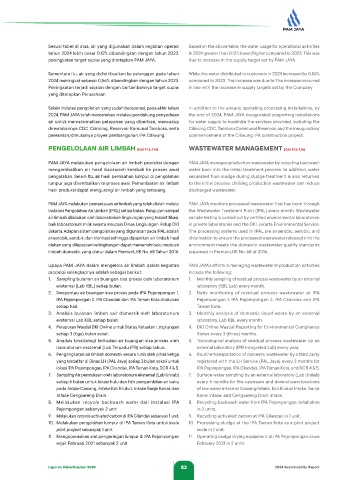
Sesuai tabel di atas, air yang digunakan dalam kegiatan operasi   Based on the above table, the water usage for operational activities
                  tahun 2024 lebih besar 0,12% dibandingkan dengan tahun 2023.   in 2024 greater than 0.12% lower/higher compared to 2023. This was
                  peningkatan target suplai yang ditetapkan PAM JAYA.  due to increase in the supply target set by PAM JAYA.


                  Sementara itu, air yang didistribusikan ke pelanggan pada tahun   While, the water distributed to customers in 2024 increased by 0.56%
                  2024 meningkat sebesar 0,56% dibandingkan dengan tahun 2023.   compared to 2023. The increase was due to The increase occurred
                  Peningkatan terjadi sejalan dengan bertambahnya target suplai   in line with the increase in supply targets set by the Company
                  yang ditetapkan Perusahaan

                  Selain instalasi pengolahan yang sudah beroperasi, pada akhir tahun   In addition to the already operating processing installations, by
                  2024, PAM JAYA telah meresmikan instalasi pendukung penyediaan   the end of 2024, PAM JAYA inaugurated supporting installations
                  air untuk memaksimalkan pelayanan yang diberikan, mencakup   for water supply to maximize the services provided, including the
                  diresmikannya CDC Cilincing, Reservoir Komunal Tambora, serta   Cilincing CDC, Tambora Communal Reservoir, and the inauguration/
                  peresmian/dimulainya proyek pembangunan IPA Ciliwung.  commencement of the Ciliwung IPA construction project.

                  PENGELOLAAN AIR LIMBAH [OJK F.13, F.14]          WASTEWATER MANAGEMENT [OJK F.13, F.14]

                  PAM JAYA melakukan pengelolaan air limbah produksi dengan   PAM JAYA manages production wastewater by recycling backwash
                  mengembalikan air hasil backwash kembali ke proses awal   water back into the initial treatment process. In addition, water
                  pengolahan. Selain itu, air hasil pemisahan lumpur di pengolahan   separated from sludge during sludge treatment is also returned
                  lumpur juga dikembalikan ke proses awal. Pemanfaatan air limbah   to the initial process. Utilizing production wastewater can reduce
                  hasil produksi dapat mengurangi air limbah yang terbuang.   discharged wastewater.

                  PAM JAYA melakukan pemantauan air limbah yang telah diolah melalui   PAM JAYA monitors processed wastewater that has been through
                  Instalasi Pengolahan Air Limbah (IPAL) setiap bulan. Pengujian sampel   the Wastewater Treatment Plant (IPAL) every month. Wastewater
                  air limbah dilakukan oleh laboratorium lingkungan yang tersertifikasi,   sample testing is carried out by certified environmental laboratories,
                  baik laboratorium milik swasta maupun Dinas Lingkungan Hidup DKI   in private laboratories and the DKI Jakarta Environmental Service.
                  Jakarta. Adapun sistem pengolahan yang digunakan pada IPAL adalah   The processing systems used in IPAL are anaerobic, aerobic, and
                  anaerobik, aerobik, dan klorinasi sehingga dipastikan air limbah hasil   chlorination to ensure the processed wastewater released into the
                  olahan yang dilepaskan ke lingkungan dapat memenuhi baku mutu air   environment meets the domestic wastewater quality standards
                  limbah domestik yang diatur dalam PermenLHK No. 68 Tahun 2016.   regulated in PermenLHK No. 68 of 2016.


                  Upaya PAM JAYA dalam mengelola air limbah dalam kegiatan   PAM JAYA’s efforts in managing wastewater in production activities
                  produksi selengkapnya adalah sebagai berikut:    include the following:
                  1.  Sampling bulanan air buangan sisa proses oleh laboratorium   1.  Monthly sampling of residual process wastewater by an external
                     eksternal (Lab KBL) setiap bulan.                laboratory (KBL Lab) every month.
                  2.  Swapantau air buangan sisa proses pada IPA Pejompongan 1,   2.  Daily monitoring of residual process wastewater at IPA
                     IPA Pejompongan 2, IPA Cilandak dan IPA Taman Kota dilakukan   Pejompongan 1, IPA Pejompongan 2, IPA Cilandak and IPA
                     setiap hari.                                     Taman Kota.
                  3.  Analisis bulanan limbah cair domestik oleh laboratorium   3.  Monthly analysis of domestic liquid waste by an external
                     eksternal Lab KBL setiap bulan.                  laboratory, Lab KBL every month.
                  4.  Pelaporan Wasdal DKI Online untuk Status Ketaatan Lingkungan   4.  DKI Online Wasdal Reporting for Environmental Compliance
                     setiap 3 (tiga) bulan sekali.                    Status every 3 (three) months.
                  5.  Analisis toksikologi terhadap air buangan sisa proses oleh   5.  Toxicological analysis of residual process wastewater by an
                     laboratorium eksternal (Lab Terpadu IPB) setiap tahun.  external laboratory (IPB Integrated Lab) every year.
                  6.  Pengangkutan air limbah domestik secara rutin oleh pihak ketiga   6.  Routine transportation of domestic wastewater by a third party
                     yang terdaftar di Dinas LH (PAL Jaya) setiap 3 bulan sekali untuk   registered with the LH Service (PAL Jaya) every 3 months for
                     lokasi IPA Pejompongan, IPA Cilandak, IPA Taman Kota, DCR 4 & 5.  IPA Pejompongan, IPA Cilandak, IPA Taman Kota, and DCR 4 & 5.
                  7.  Sampling Air permukaan oleh laboratorium eksternal (Lab Unilab)   7.  Surface water sampling by an external laboratory (Lab Unilab)
                     setiap 6 bulan untuk lokasi hulu dan hilir pengambilan air baku   every 6 months for the upstream and downstream locations
                     pada Intake Cawang, Intake Kali Krukut, Intake Banjir Kanal, dan   of raw water intake at Cawang Intake, Kali Krukut Intake, Banjir
                     Intake Cengkareng Drain.                         Kanal Intake, and Cengkareng Drain Intake.
                  8.  Melakukan  recycle backwash water  dari instalasi IPA   8.  Recycling backwash water from IPA Pejompongan installation
                     Pejompongan sebanyak 2 unit                      in 2 units.
                  9.  Melakukan recycle activated carbon di IPA Cilandak sebanyak 1 unit.  9.  Recycling activated carbon at IPA Cilandak in 1 unit.
                  10.  Melakukan pengolahan lumpur di IPA Taman Kota untuk skala   10.  Processing sludge at the IPA Taman Kota as a pilot project
                     pilot project sebanyak 1 unit                    scale in 1 unit.
                  11.  Mengoperasikan alat pengeringan lumpur di IPA Pejompongan   11.  Operating sludge drying equipment at IPA Pejompongan since
                     sejak Februari 2021 sebanyak 2 unit              February 2021 in 2 units


                  Laporan Keberlanjutan 2024                     83                               2024 Sustainability Report

