


Page 26 - 2026_AMIkids 2025 Annual Impact Report
P. 26
Non-Florida Assessments
                                                            For programs outside of Florida, the assessment of choice to measure risk and protective factors
                                                           with AMIkids youth is the YASI.

                                                          Youth Assessment & Screening Instrument (YASI)
                                                         The YASI is an assessment tool that measures risk, needs, and protective factors in at-risk and
                                                        juvenile justice-involved youth. Youth are assessed upon entering the program, reassessed at 90
                                                       days or six months, and again at discharge. Findings from the baseline YASI are used to understand
                                                     the strengths and needs of youth to provide individualized case management and treatment planning.

                                                  In 2025, the YASI was used in Florida, Louisiana, New Mexico, and South Carolina. Baseline findings
                                               from 2025 indicate that overall, youth entering these programs have risk factors that could lead to future
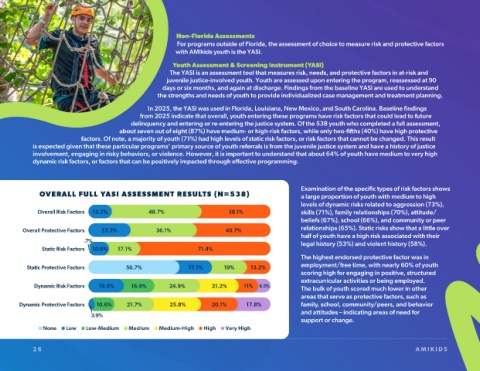
                                            delinquency and entering or re-entering the justice system. Of the 538 youth who completed a full assessment,
                                        about seven out of eight (87%) have medium- or high-risk factors, while only two-fifths (40%) have high protective
                            factors. Of note, a majority of youth (71%) had high levels of static risk factors, or risk factors that cannot be changed. This result
            is expected given that these particular programs’ primary source of youth referrals is from the juvenile justice system and have a history of justice
            involvement, engaging in risky behaviors, or violence. However, it is important to understand that about 64% of youth have medium to very high
            dynamic risk factors, or factors that can be positively impacted through effective programming.


                                                                                                    Examination of the specific types of risk factors shows
              OVERALL FULL YASI ASSESSMENT RESULTS (N=538)                                          a large proportion of youth with medium to high
                                                                                                    levels of dynamic risks related to aggression (73%),
             Overall Risk Factors  13.2%          48.7%                     38.1%                   skills (71%), family relationships (70%), attitude/
                                                                                                    beliefs (67%), school (66%), and community or peer
        Overall Protective Factors  23.2%            36.1%                 40.7%                    relationships (65%). Static risks show that a little over
                                                                                                    half of youth have a high risk associated with their
                             .7%                                                                    legal history (53%) and violent history (58%).
               Static Risk Factors  10.8%  17.1%                  71.4%
                                                                                                    The highest endorsed protective factor was in
          Static Protective Factors        50.7%               17.1%       19%      13.2%           employment/free time, with nearly 60% of youth
                                                                                                    scoring high for engaging in positive, structured
                                                                                                    extracurricular activities or being employed.
            Dynamic Risk Factors  19.5%     16.9%        24.9%         21.2%     11%   6.5%         The bulk of youth scored much lower in other
                                                                                                    areas that serve as protective factors, such as
       Dynamic Protective Factors  10.6%   21.7%         25.8%         20.1%      17.8%             family, school, community/peers, and behavior
                                                                                                    and attitudes – indicating areas of need for
                               3.9%
                                                                                                    support or change.
                None      Low      Low-Medium      Medium      Medium-High      High      Very High


            26                                                                                                                            AMIKID S                        2025 ANNU AL IMP A C T REP ORT                                                                                                        27

