


Page 22 - 2026_AMIkids 2025 Annual Impact Report
P. 22
SUBSTANCE USE

                                                                     & MENTAL HEALTH


                                                                     Families are among the most influential socializing forces in a person’s life. Research
                                                                    has demonstrated that behavioral issues during childhood can predict subsequent
                                                                    delinquency and criminal behavior. Youth who are neglected by their parents or grow
                                                                    up in homes with instability or conflict are at the greatest risk of engaging in future
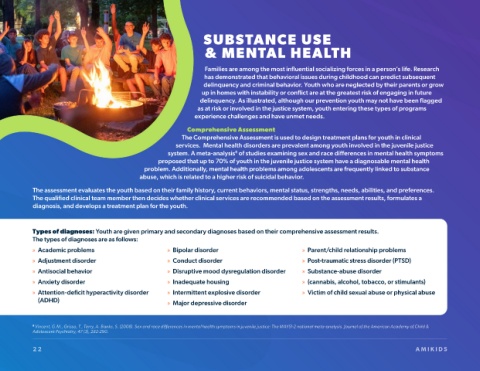
                                                                   delinquency. As illustrated, although our prevention youth may not have been flagged
                                                                  as at risk or involved in the justice system, youth entering these types of programs
                                                                 experience challenges and have unmet needs.

                                                               Comprehensive Assessment
                                                             The Comprehensive Assessment is used to design treatment plans for youth in clinical
                                                           services.  Mental health disorders are prevalent among youth involved in the juvenile justice
                                                        system. A meta-analysis  of studies examining sex and race differences in mental health symptoms
                                                                               8
                                                     proposed that up to 70% of youth in the juvenile justice system have a diagnosable mental health
                                                 problem. Additionally, mental health problems among adolescents are frequently linked to substance
                                               abuse, which is related to a higher risk of suicidal behavior.
            The assessment evaluates the youth based on their family history, current behaviors, mental status, strengths, needs, abilities, and preferences.
            The qualified clinical team member then decides whether clinical services are recommended based on the assessment results, formulates a
            diagnosis, and develops a treatment plan for the youth.


            Types of diagnoses: Youth are given primary and secondary diagnoses based on their comprehensive assessment results.
            The types of diagnoses are as follows:

               » Academic problems                         » Bipolar disorder                           » Parent/child relationship problems
               » Adjustment disorder                       » Conduct disorder                           » Post-traumatic stress disorder (PTSD)
               » Antisocial behavior                       » Disruptive mood dysregulation disorder     » Substance-abuse disorder
               » Anxiety disorder                          » Inadequate housing                         » (cannabis, alcohol, tobacco, or stimulants)

               » Attention-deficit hyperactivity disorder     » Intermittent explosive disorder         » Victim of child sexual abuse or physical abuse
              (ADHD)                                       » Major depressive disorder


            8  Vincent, G.M., Grisso, T., Terry, A. Banks, S. (2008). Sex and race differences in mental health symptoms in juvenile justice: The MAYSI-2 national meta-analysis. Journal of the American Academy of Child &
            Adolescent Psychiatry, 47 (3), 282-290.

            22                                                                                                                            AMIKID S                        2025 ANNU AL IMP A C T REP ORT                                                                                                        23

