


Page 23 - 2026_AMIkids 2025 Annual Impact Report
P. 23
SUBSTANCE USE

            & MENTAL HEALTH                                                               76%                    65%                    91%

            DIAGNOSES


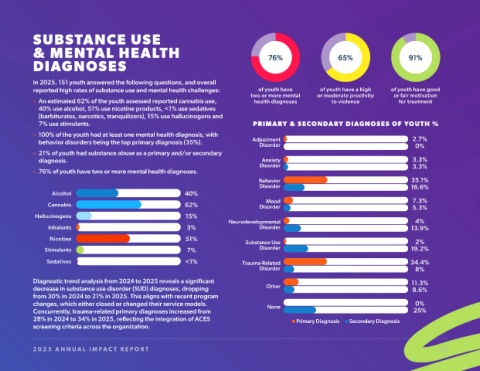
            In 2025, 151 youth answered the following questions, and overall
            reported high rates of substance use and mental health challenges:        of youth have        of youth have a high    of youth have good
                                                                                    two or more mental    or moderate proclivity   or fair motivation
               » An estimated 62% of the youth assessed reported cannabis use,       health diagnoses         to violence            for treatment
              40% use alcohol, 51% use nicotine products, <1% use sedatives
              (barbiturates, narcotics, tranquilizers), 15% use hallucinogens and
              7% use stimulants.                                                     PRIMARY & SECONDARY DIAGNOSES OF YOUTH %
               » 100% of the youth had at least one mental health diagnosis, with
              behavior disorders being the top primary diagnosis (35%).             Adjustment                                           2.7%
                                                                                       Disorder
                                                                                                                                          0%
               » 21% of youth had substance abuse as a primary and/or secondary
              diagnosis.                                                               Anxiety                                           3.3%
                                                                                       Disorder                                          3.3%
               » 76% of youth have two or more mental health diagnoses.
                                                                                      Behavior                                           35.1%
                                                                                       Disorder                                          16.6%
                  Alcohol                                     40%
                                                                                         Mood                                            7.3%
                 Cannabis                                     62%                      Disorder                                          5.3%
             Hallucinogens                                    15%
                                                                            Neurodevelopmental                                            4%
                 Inhalants                                     3%                      Disorder                                          13.9%

                 Nicotine                                     51%
                                                                                  Substance Use                                           2%
                Stimulants                                     7%                      Disorder                                          19.2%
                Sedatives                                     <1%                Trauma-Related                                          34.4%
                                                                                       Disorder                                           8%

            Diagnostic trend analysis from 2024 to 2025 reveals a significant                                                            11.3%
            decrease in substance use disorder (SUD) diagnoses, dropping                 Other                                           8.6%
            from 30% in 2024 to 21% in 2025. This aligns with recent program
            changes, which either closed or changed their service models.                None                                             0%
            Concurrently, trauma-related primary diagnoses increased from                                                                25%
            28% in 2024 to 34% in 2025, reflecting the integration of ACES                         Primary Diagnosis       Secondary Diagnosis
            screening criteria across the organization.


                                                                                                                                                  23
 22  AMIKID S  2025 ANNU AL IMP A C T REP ORT                                                                                                     23

