


Page 21 - 2026_AMIkids 2025 Annual Impact Report
P. 21
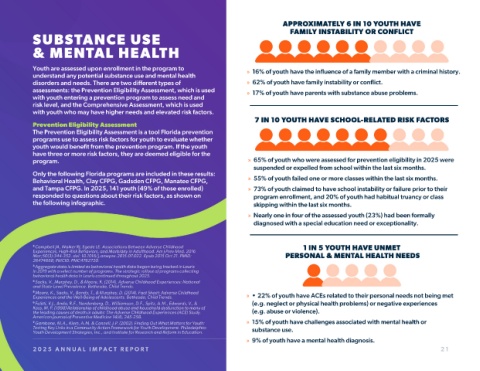
APPROXIMATELY 6 IN 10 YOUTH HAVE
                                                                                                 FAMILY INSTABILITY OR CONFLICT
            SUBSTANCE USE
            & MENTAL HEALTH


            Youth are assessed upon enrollment in the program to                     » 16% of youth have the influence of a family member with a criminal history.
            understand any potential substance use and mental health
            disorders and needs. There are two different types of                    » 62% of youth have family instability or conflict.
            assessments: the Prevention Eligibility Assessment, which is used        » 17% of youth have parents with substance abuse problems.
            with youth entering a prevention program to assess need and
            risk level, and the Comprehensive Assessment, which is used
            with youth who may have higher needs and elevated risk factors.
                                                                                     7 IN 10 YOUTH HAVE SCHOOL-RELATED RISK FACTORS
            Prevention Eligibility Assessment
            The Prevention Eligibility Assessment is a tool Florida prevention
            programs use to assess risk factors for youth to evaluate whether
            youth would benefit from the prevention program. If the youth
            have three or more risk factors, they are deemed eligible for the
            program.                                                                  » 65% of youth who were assessed for prevention eligibility in 2025 were
                                                                                     suspended or expelled from school within the last six months.
            Only the following Florida programs are included in these results:
            Behavioral Health, Clay CFPG, Gadsden CFPG, Manatee CFPG,                 » 55% of youth failed one or more classes within the last six months.
            and Tampa CFPG. In 2025, 141 youth (49% of those enrolled)                » 73% of youth claimed to have school instability or failure prior to their
            responded to questions about their risk factors, as shown on             program enrollment, and 20% of youth had habitual truancy or class
            the following infographic.                                               skipping within the last six months.

                                                                                      » Nearly one in four of the assessed youth (23%) had been formally
                                                                                     diagnosed with a special education need or exceptionality.


            2  Campbell JA, Walker RJ, Egede LE. Associations Between Adverse Childhood              1 IN 5 YOUTH HAVE UNMET
            Experiences, High-Risk Behaviors, and Morbidity in Adulthood. Am J Prev Med. 2016
            Mar;50(3):344-352. doi: 10.1016/j.amepre.2015.07.022. Epub 2015 Oct 21. PMID:       PERSONAL & MENTAL HEALTH NEEDS
            26474668; PMCID: PMC4762720.
            3  Aggregate data is limited as behavioral health data began being tracked in Lauris
            in 2019 with a select number of programs. The strategic rollout of programs collecting
            behavioral health data in Lauris continued throughout 2025.
            4  Sacks, V., Murphey, D., & Moore, K. (2014). Adverse Childhood Experiences: National
            and State-Level Prevalence. Bethesda, Child Trends.
            5  Moore, K., Sacks, V., Bandy, T., & Murphey, D. (2014). Fact Sheet: Adverse Childhood
            Experiences and the Well-Being of Adolescents. Bethesda, Child Trends.      » • 22% of youth have ACEs related to their personal needs not being met
            6  Felitti, V.J., Anda, R.F., Nordenberg, D., Williamson, D.F., Spitz, A.M., Edwards, V., &   (e.g. neglect or physical health problems) or negative experiences
            Koss, M. P. (1998) Relationship of childhood abuse and household dysfunction to many of
            the leading causes of death in adults: The Adverse Childhood Experiences (ACE) Study.   (e.g. abuse or violence).
            American Journal of Preventive Medicine 14(4), 245-258.
            7  Gambone, M.A., Klem, A.M. & Connell, J.P. (2002). Finding Out What Matters for Youth:     » 15% of youth have challenges associated with mental health or
            Testing Key Links in a Community Action Framework for Youth Development. Philadelphia:   substance use.
            Youth Development Strategies, Inc., and Institute for Research and Reform in Education.
                                                                                     » 9% of youth have a mental health diagnosis.
 20  AMIKID S  2025 ANNU AL IMP A C T REP ORT                                                                                                     2121

