


Page 36 - POSTER FYP MAC-OGOS 2025
P. 36
HELLINGER DISTANCE FOR SINGLE-VALUED NEUTROSOPHIC TOPSIS
IN EVALUATING SCIENTIFIC RESEARCH
WAN ARINA SYAKIRAH BINTI WAN RUSLI
SUPERVISOR: DR ROLIZA BINTI MD YASIN
K242/37
I. ABSTRACT V. IMPLEMENTATION
1. ABSTRACT
Part 1: Propose Hellinger Distance Measure
Evaluating scientific proposals remains a challenging undertaking in the rapidly evolving field of academic research
because of ambiguities and subjective opinions. Thus, in order to effectively manage ambiguity while evaluating
research proposals, this study integrates the Hellinger distance measure into the single-valued neutrosophic The distance measure should satisfy all of these properties
TOPSIS (SVN-TOPSIS) framework to improve existing fuzzy decision-making methods. The methodology applies
expert evaluation of secondary data from previous studies to rank four projects according to eight criteria for the
evaluation. The findings demonstrate that Euclidean, Hausdorff and Hellinger distance measures produced rankings
that are consistent by using SVN-TOPSIS method. Compared to the Hamming distance, which is simple and intuitive
but tends to overestimate specific variations and can fail to recognize the details in indeterminate evaluations.
According to the study, a more equitable and transparent evaluation tool is provided by combining probabilistic Part 2: Application of SVN-TOPSIS in the Evaluation and Selection of Scientific Research
reasoning with neutrosophic modeling. Future studies should investigate the use Hellinger distance measure in 1. SVN decision matrix and SVN criteria 2. Aggregated SVN Weighted Decision Matrix
more general fields such as engineering or healthcare applications where expert disagreement and ambiguity are
prevalent.
II. PROBLEM STATEMENT
Evaluating scientific research proposal requires consistent, unbiased and transparent effort. It is often struggle to
ensure decision-making is fair and to balance the perspectives of various experts whenever the traditional evaluation
techniques are applied. In (Smarandache et al., 2020), slow convergence is one of Delphi method major disadvantages.
For the process to achieve a high enough degree of agreement among experts, several rounds of questionnaires and
feedback are frequently needed. It can take a lot of time and if participants feel the process is going on interminably 3. Positive Ideal Solution (A+) and Negative Ideal Solution (A-) 4. Closeness Coefficient and the Project Ranking
without making any noticeable progress, it may cause them to become frustrated or disengaged. Furthermore, because
the method depends so heavily on the ongoing cooperation of experts, the quality and dependability of the results may
suffer because of the drawnout procedure.
IFS is only for truth and falsity memberships and incapable dealing with incomplete or vague information.
Meanwhile, SVNS offers more flexible to respresent uncertainty since it considers for truth, indeterminacy and falsity
memberships. The existance of indeterminacy component is helpful in real-world decision-making since there are i. Hellinger Distance of Positive Ideal Solution
situations where there is lack of information to declare something to be true or false with confidence. For instance, IFS
is great when dealing with data with confidence, but not when there is uncertainty in the data itself. Thus, SVNS is
better choice for uncertain and complex information since it provides a greather understanding of the uncertainty in
decision-making.
Besides, Hellinger distance is a useful tool in determine how similar when it is dealing with probability
distributions. Hellinger distance is a metric because the distance between two distributions is constant, giving a ii. Hellinger Distance of Negative Ideal Solution
balanced way to measure differences. Interpretation becomes easier since Hellinger distance being bounded between 0
and 1. The distance is 0 when two distributions are similar and 1 if totally distinct. This is useful in many applications
where a clear and consistent method of comparing probabilities is required, such as image recognition and clustering.
Hellinger distance also can handle small probabilities. It does not overemphasize small differences when probabilities
are near 0, in contrast to several other distance measurements. This is particularly helpful in real-world scenarios
where minor probabilities can still contain significant information but should not be the center of comparison, such as
in medical diagnosis or fraud detection.
Hence, this study proposes Hellinger distance measure in SVNS and applies in TOPSIS by using the data from
Smarandache et al. (2020) in evaluating scientific research proposals in neutrosophic environment. The data from
Smarandache et al. (2020) can be used in SVNS since the evaluation of scientific research proposals involves
uncertainty in expert judgements, indeterminacy in decision-making and neutrosophic extension of fuzzy delphi VI. RESULT & DISCUSSION
method. Finally, the ranking comparison is made with the Euclidean measure, Hamming measure and Hausdorff
measure.
III. OBJECTIVES
This table shows the project ranking of evaluating scientific research proposal in neutrosophic environment. This
To propose Hellinger distance in SVN environment. study makes the comparison ranking of four different distance measures in SVN-TOPSIS. Based on this result, it
To apply Hellinger distance measure in TOPSIS procedure to evaluate scientific research proposals. shows that ranking of Euclidean, Hausdorff and Hellinger distance are same. The firs rank is project 3 then project 4,
To compare the approved projects ranking between the Hellinger distance measure with the Euclidean, Hamming project 1 and project 2. Meanwhile, for the Hamming distance measure is project 3, project 1, project 4 and project 2.
and Hausdorff measures. Xu and Chen (2008) stated that the Euclidean and Hausdorff distances are magnitude-sensitive but not for Hamming
distance. Hence, the ranking for Hamming distance is not the same might be because of Hamming distance is not
IV. METHODOLOGY magnitude-sensitive. Based on the result, project 3 has the highest coefficient for four distance measure. By that, it
concludes that project 3 is highly recommended to be selected as scientific research proposals in academic
institutions.
VII. CONCLUSION
This study aims to address a crucial problem of uncertainty in decision-making such as how to properly and
accurately evaluate scientific research proposals when expert judgments are ambiguous, subjective or contradict.
Developing a novel Hellinger distance measure within the SVNS framework, which had not been studied before is the
main contribution. From my observation, Hellinger distance had only been discovered in IFS and probability theory.
By explicitly presenting a Hellinger distance modified for SVNS, our study closes that gap and adds to the tools
available to decision-makers working with complicated, uncertain data. It is both theoretically valid and practically
relevant since it satisfies the four properties of a legitimate distance measure. This study implements the TOPSIS
approach to rank scientific research proposals based on eight criteria evaluated by five experts using the extended
Hellinger distance in SVNS. Then, the Hellinger distance is compared with the Euclidean, Hamming and Hausdorff
distance measures. Results show that the Hamming distance generated a different outcome than the Euclidean,
Hausdorff, and Hellinger distances, which all produce consistent rankings. This difference comes from the fact that all
truth, indeterminacy, and falsity differences are equally weighted by the Hamming distance. The geometric and
probabilistic aspects of the variation are not taken into consideration only by Hamming. Unlike probabilistic measures
such as Hellinger that take into consideration what likely one distribution is to another in terms of their shape, spread,
or probability of outcomes but Hamming distance does not take chances or probability distributions into
consideration Aksoy (2000). This can cause inconsistencies in the way alternatives are ranked by overemphasizing or
underemphasizing specific differences, particularly when values are close but not equal. In short, this study shows
the benefit of SVNS in decision-making situation, as well as suggesting a new and mathematically valid distance
measure. For complex evaluations, Smarandache et al. (2020) and Marx (2011) already acknowledged that. Hence,
those related to funding academic projects, the Hellinger-SVNS-TOPSIS framework provides a more intuitive,
balanced, and uncertainty-aware method.
VIII. RECOMMENDATIONS
Based on this study, there are two recommendations can be made for future research and applications. It has been
shown that the Hellinger distance in SVNS-TOPSIS framework works well for evaluating scientific research proposals
in the context of ambiguity. It is strongly recommended that this methodology can be used in other complex decision-
making fields such as healthcare organizing or engineering project selection. This is where subjective judgment and
imprecise information are frequently present, due to its flexibility and durability. In addition, this study used
secondary data from a small number of experts. More experts should be taken into consideration for future research
to collect primary data. Expert agreement may be more thorough and of higher quality if real-time input is
incorporated using organized techniques like the Delphi process. The evaluation procedure would become more
contextually grounded and representative as a result.
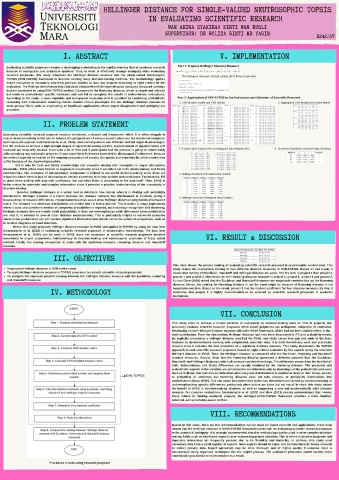
Procedure in evaluating research proposal

