


Page 38 - POSTER FYP MAC-OGOS 2025
P. 38
NUR AIREEN NATASYA DR SITI FARAH HARYATIE K242/39
BINTI MARZELAN BINTI MOHD KANAFIAH
SOLVING VISCOUS FLUID MODEL USING RUNGE-KUTTA
FEHLBERG FOURTH-FIFTH(RKF45) METHOD FOR HEAT
TRANSFER PROBLEM PASSING OVER STRETCHING SHEET
"Let’s dive
"Heat transfer +
into the problem viscous fluid +
we’re solving..." RKF45 = real-world
ABSTRACT PROBLEM STATEMENT challenge!"
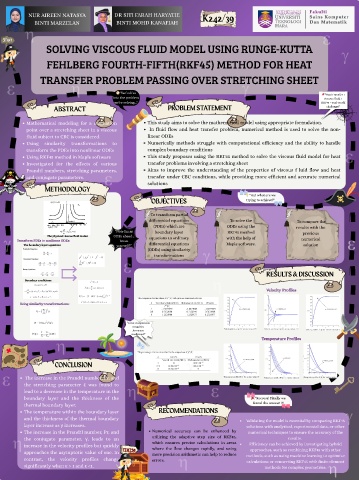
Mathematical modeling for a stagnation This study aims to solve the mathematical model using appropriate formulation.
point over a stretching sheet in a viscous In fluid flow and heat transfer problem, numerical method is used to solve the non-
fluid subject to CBC is considered. linear ODEs
Using similarity transformations to Numerically methods struggle with computational efficiency and the ability to handle
transform the PDEs into nonlinear ODEs complex boundary conditions
Using RKF45 method in Maple software This study proposes using the RKF45 method to solve the viscous fluid model for heat
Investigated for the effects of various transfer problems involving a stretching sheet
Prandtl numbers, stretching parameters, Aims to improve the understanding of the properties of viscous f luid flow and heat
and conjugate parameters. transfer under CBC conditions, while providing more efficient and accurate numerical
solutions
METHODOLOGY
"But what are we
OBJECTIVES trying to achieve?"
To transform partial
differential equations To solve the To compare the
(PDEs) which are ODEs using the results with the
“Non-linear boundary layer RKF45 method previous
The physical viscous fluid model: ODEs ahead... equations to ordinary with the help of
Transform PDEs to nonlinear ODEs: brace numerical
The boundary layer equations: yourself!” differential equations Maple software. solution
(ODEs) using similarity
transformations
RESULTS & DISCUSSION
Boundary conditions:
Velocity Profiles
Using similarity transformations:
“Error comparison
complete.
Accuracy
confirmed.”
Temperature Profiles
CONCLUSION
The increase in the Prandtl number, Pr, and
the stretching parameter ε was found to
lead to a decrease in the temperature in the
boundary layer and the thickness of the "Success! Finally we
thermal boundary layer. found the answer !!!
The temperature within the boundary layer RECOMMENDATIONS
and the thickness of the thermal boundary
Validating the model is essential by comparing RKF45
layer increase as γ increases. solutions with analytical, experimental data, or other
The increase in the Prandtl number, Pr, and Numerical accuracy can be enhanced by numerical techniques to ensure the accuracy of the
the conjugate parameter, γ, leads to an utilizing the adaptive step size of RKF45, results.
which ensures precise calculations in areas
increase in the velocity profiles but quickly Efficiency can be achieved by investigating hybrid
where the flow changes rapidly, and using approaches, such as combining RKF45 with other
approaches the asymptotic value of one. In more precision arithmetic can help to reduce
contrast, the velocity profiles change errors. methods, such as using machine learning to optimize
calculations or connecting RKF45 with finite element
significantly when ε > 1 and ε <1. methods for complex geometries.

