


Page 40 - POSTER FYP MAC-OGOS 2025
P. 40
OPTIMIZATION OF SCHOOL BUSES ROUTING PROBLEM K242/41
(SBRP) USING GENETIC ALGORITHM APPROACH
ILLI SYAFIQAH BINTI ABDUL RAZAK SUPERSISOR:
2023680518 PUAN WAN NURFAHIZUL IFWAH BT WAN ALIAS
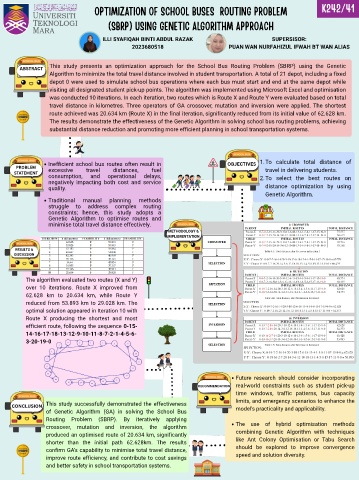
This study presents an optimization approach for the School Bus Routing Problem (SBRP) using the Genetic
ABSTRACT
Algorithm to minimize the total travel distance involved in student transportation. A total of 21 depot, including a fixed
depot 0 were used to simulate school bus operations where each bus must start and end at the same depot while
visiting all designated student pick-up points. The algorithm was implemented using Microsoft Excel and optimisation
was conducted 10 iterations. In each iteration, two routes which is Route X and Route Y were evaluated based on total
travel distance in kilometres. Three operators of GA crossover, mutation and inversion were applied. The shortest
route achieved was 20.634 km (Route X) in the final iteration, significantly reduced from its initial value of 62.628 km.
The results demonstrate the effectiveness of the Genetic Algorithm in solving school bus routing problems, achieving
substantial distance reduction and promoting more efficient planning in school transportation systems.
Inefficient school bus routes often result in OBJECTIVES 1.To calculate total distance of
PROBLEM excessive travel distances, fuel travel in delivering students.
STATEMENT
consumption, and operational delays, 2.To select the best routes on
negatively impacting both cost and service
quality. distance optimization by using
Genetic Algorithm.
Traditional manual planning methods
struggle to address complex routing
constraints; hence, this study adopts a
Genetic Algorithm to optimise routes and
minimise total travel distance effectively.
METHODOLOGY &
IMPLEMENTATION
RESULTS &
DISCUSSION
The algorithm evaluated two routes (X and Y)
over 10 iterations. Route X improved from
62.628 km to 20.634 km, while Route Y
reduced from 53.893 km to 29.028 km. The
optimal solution appeared in Iteration 10 with
Route X producing the shortest and most
efficient route, following the sequence 0-15-
14-16-17-18-13-12-9-10-11-8-7-2-1-4-5-6-
3-20-19-0
Future research should consider incorporating
RECOMMENDATION real-world constraints such as student pick-up
time windows, traffic patterns, bus capacity
limits, and emergency scenarios to enhance the
CONCLUSION This study successfully demonstrated the effectiveness model’s practicality and applicability.
of Genetic Algorithm (GA) in solving the School Bus
Routing Problem (SBRP). By iteratively applying
crossover, mutation and inversion, the algorithm The use of hybrid optimisation methods
produced an optimised route of 20.634 km, significantly combining Genetic Algorithm with techniques
shorter than the initial path 62.628km. The results like Ant Colony Optimisation or Tabu Search
confirm GA’s capability to minimise total travel distance, should be explored to improve convergence
improve route efficiency, and contribute to cost savings speed and solution diversity.
and better safety in school transportation systems.

