


Page 24 - The Insurance Times November 2025
P. 24
premium rates, and second, a reputational risk that  4.0 Core Risk Category: Operational &
             could, in extreme cases, make it difficult to place
             reinsurance coverage in the future.              Enterprise Risks
                                                              Operational risks are defined as the risk of loss resulting from
          3.2 Lapse and Withdrawal Risk                       inadequate or failed internal processes, people, and systems,
                                                              or  from external events.  Alongside  these  are critical
          Lapse Risk is the adverse financial impact that occurs when
                                                              enterprise-level risks, such as regulatory and reputational
          the actual rate of policy lapses is higher than the rate
          anticipated during pricing. High lapse rates can erode  challenges,  which  can  have  wide-ranging  strategic
          profitability in several ways:                      consequences for the entire organization. These risks are
          1. Increased Per-Policy Expense: A significant portion of  not tied to underwriting or market fluctuations but to the
             an insurer's expenses are fixed. When policies lapse,  very fabric of how the company operates and is perceived.
             these fixed costs must be spread over a smaller in-force  The following sections detail these crucial risk categories.
             policy base, driving up the per-policy expense.
                                                              4.1 Operational Risk
          2. Non-Recovery of Initial Costs: Insurers incur high
             upfront costs, including commissions and underwriting  Operational risk management follows a model where a
             expenses, when issuing a new policy. These costs are  cause  leads  to  an  event,  which  in  turn  leads  to  a
             expected to be recouped over the life of the policy. High  consequence. The cause is the underlying failure, the event
             lapse rates, particularly in the early years, prevent the  is the operational failure itself, and the consequence is the
             full recovery of these initial expenses.         resulting loss, which can be financial, reputational, or
                                                              customer-related. The severity of the loss is measured by
          3. Reduced Company Value: A high lapse rate erodes the  its likelihood and its potential impact.
             future profit stream from the in-force book of business,
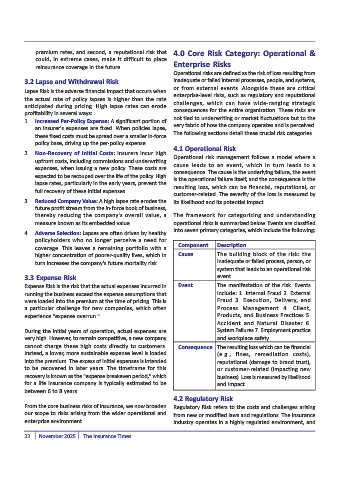
             thereby  reducing  the  company's  overall  value,  a  The  framework  for  categorizing  and  understanding
             measure known as its embedded value.             operational risks is summarized below. Events are classified
          4. Adverse Selection: Lapses are often driven by healthy  into seven primary categories, which include the following:
             policyholders who no  longer  perceive  a  need  for
             coverage. This leaves a remaining portfolio with a  Component   Description
             higher concentration of poorer-quality lives, which in  Cause   The  building  block  of  the  risk:  the
             turn increases the company's future mortality risk.             inadequate or failed process, person, or
                                                                             system that leads to an operational risk
          3.3 Expense Risk                                                   event.
          Expense Risk is the risk that the actual expenses incurred in  Event  The manifestation of the risk. Events
          running the business exceed the expense assumptions that           include: 1. Internal Fraud 2. External
          were loaded into the premium at the time of pricing. This is       Fraud  3.  Execution,  Delivery,  and
          a particular challenge for new companies, which often              Process  Management  4.  Client,
          experience "expense overrun."                                      Products, and Business Practices  5.
                                                                             Accident  and  Natural  Disaster  6.
          During the initial years of operation, actual expenses are         System Failures 7. Employment practice
          very high. However, to remain competitive, a new company           and workplace safety.
          cannot charge these high costs directly to customers.  Consequence The resulting loss which can be financial
          Instead, a lower, more sustainable expense level is loaded         (e.g.,  fines,  remediation  costs),
          into the premium. The excess of initial expenses is intended       reputational (damage to brand trust),
          to be recovered in later years. The timeframe for this             or customer-related (impacting new
          recovery is known as the "expense breakeven period," which         business). Loss is measured by likelihood
          for a life insurance company is typically estimated to be          and impact.
          between 6 to 8 years.
                                                              4.2 Regulatory Risk
          From the core business risks of insurance, we now broaden  Regulatory Risk refers to the costs and challenges arising
          our scope to risks arising from the wider operational and  from new or modified laws and regulations. The insurance
          enterprise environment.                             industry operates in a highly regulated environment, and

         22    November 2025  The Insurance Times

