


Page 371 - Ranah Studi Agraria: Penguasaan Tanah dan Hubungan Agraris
P. 371
Ranah Studi Agraria

            fallow. Three villages (Kebanggan, Geneng, and Janti) lie within
            the catchment area of sugar factories and between 20 and 35%
            of their sawah is reserved in rotation for sugarcane cultiva-
            tion as it has been since the colonial period. This land was
            formerly rented to the factories by its smallholder owners and
            its cultivation undertaken by the factories using wage labor,
            but since the introduction of the new TRI or TRIS (smallholder
            sugarcane intensification) programs in the late 1970s sugar-
            cane is now cultivated by groups of smallholders themselves
            and sold to the factories.


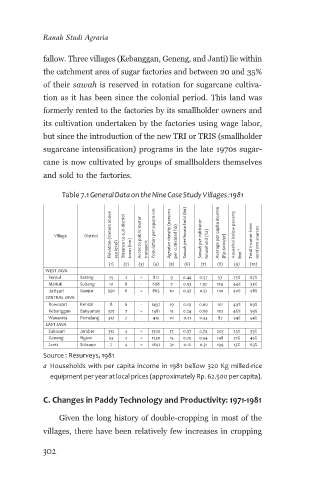
                Table 7.1 General Data on the Nine Case Study Villages :1981

                             Elevation (meters above  Population per square km  Agrarian density (persons  Sawah per house hold (ha)  Average per capita income  Househol below poverty

               Village  District  sea level)  Distance to sub-district  town (km)  Acces to public motor  transport  per cultivated ha)  Sawah per cultivator  household (ha)  {Rp 6000/yr}  Total income from  nonfarm sources


                            (1)  (2)  (3)  (4)  (5)  (6)  (7)  (8)  (9) line a  (10)
            WEST JAVA
             Sentul  Serang  25  2  +  812  9  0.44  0.57  57  75%  67%
             Mariuk  Subang  10  8  -  658  7  0.53  1.52  124  44%  33%
             Jatisari
             Jarisari  Cianjur  350  6  +  865  10  0.37  0.51  140  40%  48%
            CENTRAL JAVA
             Rowosari  Kendal  8  6  -  1437  19  0.19  0.60  101  49%  69%
             Kebanggan  Banyumas  325  7  +  1481  15  0.24  0.59  102  46%  59%
             Wanarata  Pemalang  312  7  -  413  10  0.21  0.33  87  54%  54%
            EAST JAVA
             Sukosari  Jember  312  4  +  1300  17  0.37  0.74  205  25%  55%
             Geneng  Ngawi  53  2   +  1230  15  0.25  0.54  148  22%  45%
             Janti   Sidoarjo  7  4  +  1842  31  0.12  0.31  199  13%  63%
            Source : Resurveys, 1981
            a Households with per capita income in 1981 bellow 320 Kg milled-rice
             equipment per year at local prices (approximately Rp. 62.500 per capita).

            C. Changes in Paddy Technology and Productivity: 1971-1981

                Given the long history of double-cropping in most of the
            villages, there have been relatively few increases in cropping

            302

