


Page 339 - American Stories, A History of the United States
P. 339
13.1                                        Read the Document  Samuel Morse, Danger of foreign Immigration (1835)


            13.2


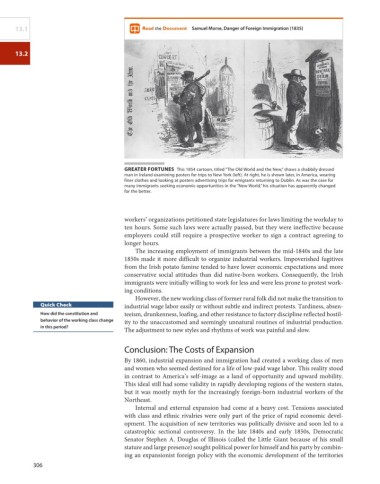
                                                GReAteR foRtUneS  this 1854 cartoon, titled “the Old World and the New,” shows a shabbily dressed
                                                man in ireland examining posters for trips to New York (left). At right, he is shown later, in America, wearing
                                                finer clothes and looking at posters advertising trips for emigrants returning to Dublin. As was the case for
                                                many immigrants seeking economic opportunities in the “New World,” his situation has apparently changed
                                                for the better.


                                                workers’ organizations petitioned state legislatures for laws limiting the workday to
                                                ten hours. Some such laws were actually passed, but they were ineffective because
                                                employers could still require a prospective worker to sign a contract agreeing to
                                                longer hours.
                                                    The increasing employment of immigrants between the mid-1840s and the late
                                                1850s made it more difficult to organize industrial workers. Impoverished fugitives
                                                from the Irish potato famine tended to have lower economic expectations and more
                                                conservative social attitudes than did native-born workers. Consequently, the Irish
                                                immigrants were initially willing to work for less and were less prone to protest work-
                                                ing conditions.
                                                    However, the new working class of former rural folk did not make the transition to
                     Quick Check                industrial wage labor easily or without subtle and indirect protests. Tardiness, absen-
                     how did the constitution and   teeism, drunkenness, loafing, and other resistance to factory discipline reflected hostil-
                       behavior of the working class change   ity to the unaccustomed and seemingly unnatural routines of industrial production.
                     in this period?
                                                The adjustment to new styles and rhythms of work was painful and slow.

                                                conclusion: the costs of expansion

                                                By 1860, industrial expansion and immigration had created a working class of men
                                                and women who seemed destined for a life of low-paid wage labor. This reality stood
                                                in contrast to America’s self-image as a land of opportunity and upward mobility.
                                                This ideal still had some validity in rapidly developing regions of the western states,
                                                but it was mostly myth for the increasingly foreign-born industrial workers of the
                                                Northeast.
                                                    Internal and external expansion had come at a heavy cost. Tensions associated
                                                with class and ethnic rivalries were only part of the price of rapid economic devel-
                                                opment. The acquisition of new territories was politically divisive and soon led to a
                                                catastrophic sectional controversy. In the late 1840s and early 1850s, Democratic
                                                  Senator Stephen A. Douglas of Illinois (called the Little Giant because of his small
                                                stature and large presence) sought political power for himself and his party by combin-
                                                ing an expansionist foreign policy with the economic development of the territories
                  306

