


Page 335 - American Stories, A History of the United States
P. 335
The essential features of the emerging mode
            13.1                                                             of production were gathering a supervised work-
                                                                             force in a single place, paying cash wages to work-
                                                                             ers, using interchangeable parts, and manufacturing
                                       BRITISH NORTH AMERICA
            13.2                             (CANADA)                        by “continuous process.” Within a factory setting,
                                                                             a sequence of continuous operations could rapidly
                                                                             and efficiently assemble standardized parts, manu-
                                                                 Boston      factured separately and in bulk, into a final product.
                                       Great Lakes
                                                                             Mass production, which involved the division of
                                       Detroit                               labor into a series of relatively simple and repetitive
                                                             New York
                                                Pittsburgh                   tasks, contrasted sharply with the traditional craft
                                                           Philadelphia      mode of production, in which a single worker pro-
                         Chicago
                                                         Washington, D.C.    duced the entire product out of raw materials.
                                                                                The transition to mass production often
                       St.                 Cincinnati                        depended on new technology. Just as power looms
                       Joseph
                                                                             and spinning machinery had made textile mills
                        St. Louis                                            possible, new and more reliable machines or indus-
                                                             ATLANTIC
                                                               OCEAN         trial techniques revolutionized other industries.
                                                        Charleston           Elias Howe’s invention of the sewing machine in
                                                                             1846 laid the basis for the ready-to-wear clothing
                                                                             industry and contributed to the mechanization of
                                                                             shoemaking. During the 1840s, iron manufactur-
                                                                             ers adopted the British practice of using coal rather
                          New Orleans                                        than charcoal for smelting and thus produced a
                         Houston
                                                                             metal better  suited to industrial needs. Charles
                                                                             Goodyear’s discovery in 1839 of the process for
                                    Gulf of Mexico
                                                                             vulcanizing rubber made new manufactured items
                                                             Railroads       available to the American consumer, most notably
                                                             in 1850
                           0      200    400 miles           Railroads built  the overshoe.
                                                             between 1850       Perhaps the greatest triumph of mid-
                           0   200  400 kilometers           and 1860
                                                                             nineteenth-century American technology was the
                                                                             development  of  the  world’s  most  sophisticated
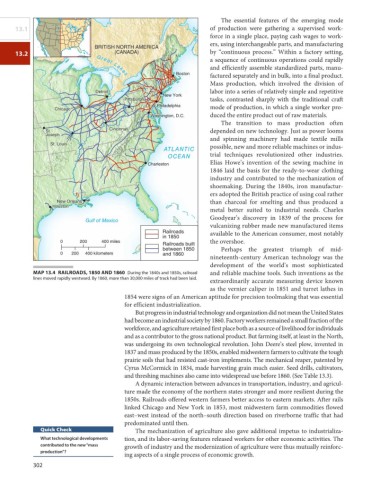
                  mAP 13.4  RAilRoAdS, 1850 And 1860  During the 1840s and 1850s, railroad   and reliable machine tools. Such inventions as the
                  lines moved rapidly westward. by 1860, more than 30,000 miles of track had been laid.
                                                                             extraordinarily accurate measuring device known
                                                                             as the vernier caliper in 1851 and turret lathes in
                                                1854 were signs of an American aptitude for precision toolmaking that was essential
                                                for efficient industrialization.
                                                    But progress in industrial technology and organization did not mean the United States
                                                had become an industrial society by 1860. Factory workers remained a small fraction of the
                                                workforce, and agriculture retained first place both as a source of livelihood for individuals
                                                and as a contributor to the gross national product. But farming itself, at least in the North,
                                                was undergoing its own technological revolution. John Deere’s steel plow, invented in
                                                1837 and mass produced by the 1850s, enabled midwestern farmers to cultivate the tough
                                                prairie soils that had resisted cast-iron implements. The mechanical reaper, patented by
                                                Cyrus McCormick in 1834, made harvesting grain much easier. Seed drills, cultivators,
                                                and threshing machines also came into widespread use before 1860. (See Table 13.3).
                                                    A dynamic interaction between advances in transportation, industry, and agricul-
                                                ture made the economy of the northern states stronger and more resilient during the
                                                1850s. Railroads offered western farmers better access to eastern markets. After rails
                                                linked Chicago and New York in 1853, most midwestern farm commodities flowed
                                                east–west instead of the north–south direction based on riverborne traffic that had
                                                predominated until then.
                     Quick Check                    The mechanization of agriculture also gave additional impetus to industrializa-
                     What technological developments   tion, and its labor-saving features released workers for other economic activities. The
                     contributed to the new “mass   growth of industry and the modernization of agriculture were thus mutually reinforc-
                     production”?
                                                ing aspects of a single process of economic growth.
                  302

