


Page 337 - American Stories, A History of the United States
P. 337
Mass immigration begins
            13.1                                The incentive to mechanize northern industry and agriculture came in part from a

                                                shortage of cheap labor. Compared to the industrializing nations of Europe, the econ-
                                                omy of the United States in the early nineteenth century was labor-scarce. Since it was
            13.2                                difficult to attract able-bodied men to work for low wages in factories or on farms,
                                                women and children were used extensively in the early textile mills, and commercial
                                                farmers had to rely on the labor of their family members. Labor-saving machinery
                                                eased but did not solve the labor shortage. Factories required more operatives. Railroad
                                                builders needed construction gangs. The growth of industrial work attracted many
                                                European immigrants during the two decades before the Civil War.
                                                    Between 1820 and 1840, an estimated 700,000 immigrants arrived in the United
                                                States, mainly from the British Isles and German-speaking areas of continental Europe.
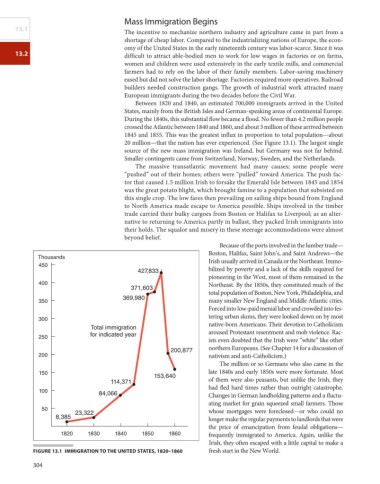
                                                During the 1840s, this substantial flow became a flood. No fewer than 4.2 million people
                                                crossed the Atlantic between 1840 and 1860, and about 3 million of these arrived between
                                                1845 and 1855. This was the greatest influx in proportion to total population—about
                                                20 million—that the nation has ever experienced. (See Figure 13.1). The largest single
                                                source of the new mass immigration was Ireland, but Germany was not far behind.
                                                Smaller contingents came from Switzerland, Norway, Sweden, and the Netherlands.
                                                    The  massive  transatlantic movement  had many  causes;  some  people  were
                                                “pushed” out of their homes; others were “pulled” toward America. The push fac-
                                                tor that caused 1.5 million Irish to forsake the Emerald Isle between 1845 and 1854
                                                was the great potato blight, which brought famine to a population that subsisted on
                                                this single crop. The low fares then prevailing on sailing ships bound from England
                                                to North America made escape to America possible. Ships involved in the timber
                                                trade carried their bulky cargoes from Boston or Halifax to Liverpool; as an alter-
                                                native to returning to America partly in ballast, they packed Irish immigrants into
                                                their holds. The squalor and misery in these steerage accommodations were almost
                                                beyond belief.
                                                                                Because of the ports involved in the lumber trade—
                                                                            Boston, Halifax, Saint John’s, and Saint Andrews—the
                    Thousands                                               Irish usually arrived in Canada or the Northeast. Immo-
                    450
                                                     427,833                bilized by poverty and a lack of the skills required for
                                                                            pioneering in the West, most of them remained in the
                    400                                                     Northeast. By the 1850s, they constituted much of the
                                                   371,603
                                                                            total population of Boston, New York,  Philadelphia, and
                                                369,980
                    350                                                     many smaller New England and Middle  Atlantic cities.
                                                                            Forced into low-paid menial labor and crowded into fes-
                                                                            tering urban slums, they were looked down on by most
                    300
                                     Total immigration                      native-born Americans. Their devotion to Catholicism
                    250              for indicated year                     aroused Protestant resentment and mob violence. Rac-
                                                                            ists even doubted that the Irish were “white” like other
                                                                200,877     northern Europeans. (See Chapter 14 for a discussion of
                    200                                                     nativism and anti-Catholicism.)
                                                                                The million or so Germans who also came in the
                    150                                   153,640           late 1840s and early 1850s were more fortunate. Most
                                            114,371                         of them were also peasants, but unlike the Irish, they
                    100                 84,066                              had fled hard times rather than outright catastrophe.
                                                                            Changes in German landholding patterns and a fluctu-
                                                                            ating market for grain squeezed small farmers. Those
                     50         23,322                                      whose mortgages were foreclosed—or who could no
                          8,385                                             longer make the regular payments to landlords that were
                                                                            the price of emancipation from feudal obligations—
                            1820    1830     1840     1850     1860         frequently immigrated to America. Again, unlike the
                                                                            Irish, they often escaped with a little capital to make a
                  fiGURe 13.1  immiGRAtion to tHe United StAteS, 1820–1860   fresh start in the New World.

                  304

