


Page 383 - American Stories, A History of the United States
P. 383
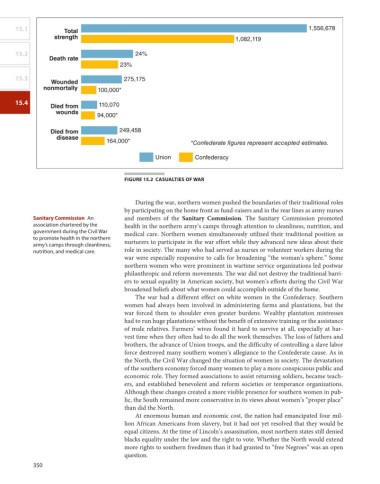
15.1             Total                                                                           1,556,678
                         strength                                                    1,082,119

            15.2                                    24%
                        Death rate
                                               23%

            15.3                                275,175
                        Wounded
                      nonmortally       100,000*
            15.4
                        Died from       110,070
                          wounds
                                       94,000*

                        Died from              249,458
                          disease
                                           164,000*                   *Confederate figures represent accepted estimates.

                                                           Union        Confederacy


                                                fiGUre 15.2  casUaLties of war


                                                    During the war, northern women pushed the boundaries of their traditional roles
                                                by participating on the home front as fund-raisers and in the rear lines as army nurses
                  sanitary commission  An       and members of the  Sanitary Commission. The Sanitary Commission promoted
                  association chartered by the   health in the northern army’s camps through attention to cleanliness, nutrition, and
                  government during the Civil War   medical care. Northern women simultaneously utilized their traditional position as
                  to promote health in the northern
                  army’s camps through cleanliness,   nurturers to participate in the war effort while they advanced new ideas about their
                  nutrition, and medical care.  role in society. The many who had served as nurses or volunteer workers during the
                                                war were especially responsive to calls for broadening “the woman’s sphere.” Some
                                                northern women who were prominent in wartime service organizations led postwar
                                                philanthropic and reform movements. The war did not destroy the traditional barri-
                                                ers to sexual equality in American society, but women’s efforts during the Civil War
                                                broadened beliefs about what women could accomplish outside of the home.
                                                    The war had a different effect on white women in the Confederacy. Southern
                                                women had always been involved in administering farms and plantations, but the
                                                war forced them to shoulder even greater burdens. Wealthy plantation mistresses
                                                had to run huge plantations without the benefit of extensive training or the assistance
                                                of male relatives. Farmers’ wives found it hard to survive at all, especially at har-
                                                vest time when they often had to do all the work themselves. The loss of fathers and
                                                brothers, the advance of Union troops, and the difficulty of controlling a slave labor
                                                force destroyed many southern women’s allegiance to the Confederate cause. As in
                                                the North, the Civil War changed the situation of women in society. The devastation
                                                of the southern economy forced many women to play a more conspicuous public and
                                                economic role. They formed associations to assist returning soldiers, became teach-
                                                ers, and established benevolent and reform societies or temperance organizations.
                                                Although these changes created a more visible presence for southern women in pub-
                                                lic, the South remained more conservative in its views about women’s “proper place”
                                                than did the North.
                                                    At enormous human and economic cost, the nation had emancipated four mil-
                                                lion African Americans from slavery, but it had not yet resolved that they would be
                                                equal citizens. At the time of Lincoln’s assassination, most northern states still denied
                                                blacks equality under the law and the right to vote. Whether the North would extend
                                                more rights to southern freedmen than it had granted to “free Negroes” was an open
                                                question.
                  350

