


Page 382 - American Stories, A History of the United States
P. 382
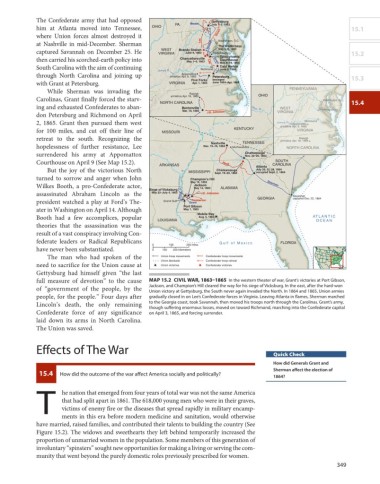
The  Confederate army that had opposed             Meade  Gettysburg
                   him at Atlanta moved into Tennessee,   OHIO   PA.         July 1–3, 1863                                15.1
                   where Union forces almost destroyed it                      Stuart
                   at Nashville in mid-December. Sherman                 Lee  Hooker  Washington, D.C.
                                                                               The Wilderness
                                                            WEST
                   captured Savannah on December 25. He     VIRGINIA  Brandy Station  Fredericksburg                       15.2
                                                                               May 5–6, 1864
                                                                    June 9, 1863
                   then carried his scorched-earth policy into     Chancellorsville  Lee  Grant Spotsylvania
                                                                                Courthouse
                                                                     May 1–4, 1863
                                                                                May 8–19, 1864
                   South Carolina with the aim of continuing   James R.   Richmond  Cold Harbor
                                                                                June 3, 1864
                   through North Carolina and joining up       armistice Apr. 9, 1865  Petersburg                          15.3
                                                                   Appomattox
                   with Grant at Petersburg.                   VIRGINIA  Five Forks  besieged
                                                                             June 1864–Apr. 1865
                                                                       Apr. 1, 1865
                       While Sherman was invading the                 Raleigh                          PENNSYLVANIA
                   Carolinas, Grant finally forced the starv-  NORTH CAROLINA               OHIO                  Washington, D.C.  15.4
                                                                armistice Apr. 18, 1865
                   ing and exhausted Confederates to aban-         Bentonville            Ohio  R.  WEST         Fredericksburg
                   don Petersburg and Richmond on April            Mar. 19, 1865  J.E. Johnston    VIRGINIA
                   2, 1865. Grant then pursued them west                                           James R.  Appomattox Richmond
                   for  100 miles, and  cut off  their line  of   MISSOURI          KENTUCKY        armistice Apr. 9, 1865
                                                                                                         VIRGINIA
                   retreat to the south. Recognizing the                                            armistice Apr. 18, 1865
                                                                                                          Raleigh
                                                                                       TENNESSEE
                                                                             Nashville
                   hopelessness of further resistance, Lee                Dec. 15–16, 1864  Murfreesboro  NORTH CAROLINA
                   surrendered his army at   Appomattox                                 Chattanooga
                                                                                        Nov. 23–25, 1863
                   Courthouse on April 9 (See Map 15.2).    ARKANSAS             Hood            CAROLINA
                                                                                                  SOUTH
                       But the joy of the victorious North            MISSISSIPPI  Sept. 19–20, 1863  Atlanta
                                                                                            July 20, 22, 28, 1864
                                                                               Chickamauga
                                                                                            occupied Sept. 2, 1864
                   turned to sorrow and anger when John            Mississippi    R.  Champion's Hill
                     Wilkes Booth, a pro-Confederate actor,   Siege of Vicksburg  May 16, 1863  ALABAMA  Sherman
                                                                       Jackson
                                                                       May 14, 1863
                   assassinated Abraham Lincoln as the   May 22–July 4, 1863  Grant  J.E. Johnston      Savannah
                   president watched a play at Ford’s The-   Grand Gulf  Grant              GEORGIA     captured Dec. 22, 1864
                                                                       Pemberton
                   ater in Washington on April 14. Although         Port Gibson
                                                                    May 1, 1863
                   Booth had a few accomplices, popular    LOUISIANA    Mobile Bay                            ATLANTIC
                                                                         Aug. 5, 1864
                                                                                                               OCEAN
                   theories that the assassination was the
                   result of a vast conspiracy involving Con-
                   federate leaders or Radical Republicans   0  100  200 miles  Gulf of Me xic o    FLORIDA
                   have never been substantiated.         0  100  200 kilometers
                       The man who had spoken of the        Union troop movements  Confederate troop movements
                   need to sacrifice for the Union cause at   Union blockade  Confederate troop retreat
                                                                           Confederate victories
                                                            Union victories
                     Gettysburg had himself given “the last
                   full measure of devotion” to the cause   MAP 15.2  CIVIL WAR, 1863–1865  In the western theater of war, Grant’s victories at Port Gibson,
                   of “government of the people, by the   Jackson, and Champion’s Hill cleared the way for his siege of Vicksburg. In the east, after the hard-won
                                                        Union victory at Gettysburg, the South never again invaded the North. In 1864 and 1865, Union armies
                   people, for the people.” Four days after   gradually closed in on Lee’s Confederate forces in Virginia. Leaving Atlanta in flames, Sherman marched
                   Lincoln’s death, the only remaining   to the Georgia coast, took Savannah, then moved his troops north through the Carolinas. Grant’s army,
                                                        though suffering enormous losses, moved on toward Richmond, marching into the Confederate capital
                   Confederate force of any significance   on April 3, 1865, and forcing surrender.
                   laid down its arms in North Carolina.
                   The Union was saved.
                   Effects of The War                                                            Quick Check
                                                                                                 How did Generals Grant and
                                                                                                   Sherman affect the election of
                     15.4   How did the outcome of the war affect America socially and politically?  1864?
                    T       he nation that emerged from four years of total war was not the same  America
                            that had split apart in 1861. The 618,000 young men who were in their graves,
                            victims of enemy fire or the diseases that spread rapidly in  military encamp-
                            ments in this era before modern medicine and sanitation, would otherwise
                   have married, raised families, and contributed their talents to building the country (See
                   Figure 15.2). The widows and sweethearts they left behind temporarily increased the
                   proportion of unmarried women in the population. Some members of this generation of
                   involuntary “spinsters” sought new opportunities for making a  living or serving the com-
                   munity that went beyond the purely domestic roles previously prescribed for women.
                                                                                                                      349

