


Page 377 - American Stories, A History of the United States
P. 377
Since there was no response from the South and little enthusiasm in Congress for
            15.1                                Lincoln’s gradual plan, the president went ahead on January 1, 1863, and declared that
                                                all slaves in those areas under Confederate control “shall be . . . thenceforward, and
                                                forever free.” He justified the final proclamation as an act of “military necessity” sanc-
            15.2                                tioned by the war powers of the president, and he authorized the enlistment of freed
                                                slaves in the Union army. The language and tone of the document—one historian has
                                                described it as having “all the moral grandeur of a bill of lading”—made it clear that

            15.3                                blacks were being freed for reasons of state and not out of humanitarian conviction.
                                                    Despite its uninspiring origin and limited application—it did not extend to slave states
                                                loyal to the Union or to occupied areas and thus did not immediately free a single slave—the
                                                proclamation did commit the Union to abolishing slavery as a war aim. It also accelerated
            15.4
                                                the breakdown of slavery as a labor system, a process that was already under way by early
                                                1863. The blacks who had remained in captured areas or deserted their masters to cross
                                                Union lines before 1863 had been kept in a kind of way station between slavery and free-
                                                dom, in accordance with the theory that they were “contraband of war.” As word spread
                                                among the slaves that emancipation was now official policy, more of them were inspired to
                                                run off and seek the protection of northern armies. One slave who crossed the Union lines
                     Quick Check                summed up their motives: “I wants to be free. I came in from the plantation and don’t want
                     Why was Lincoln skeptical of   to go back; . . . I don’t want to be a slave again.” Approximately one-quarter of the slave
                       immediate emancipation, and    population gained freedom during the war under the terms of the Emancipation Proclama-
                     what changed his mind?
                                                tion and thus deprived the South of an important part of its agricultural workforce.
                                                African Americans and the War

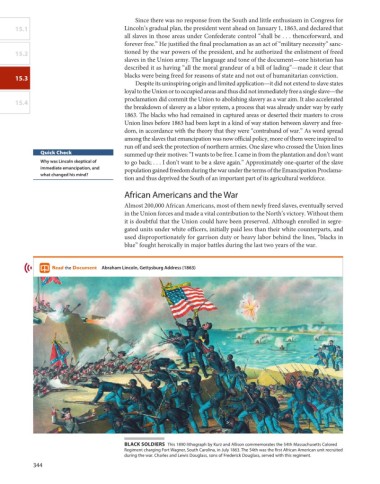
                                                Almost 200,000 African Americans, most of them newly freed slaves, eventually served
                                                in the Union forces and made a vital contribution to the North’s victory. Without them
                                                it is doubtful that the Union could have been preserved. Although enrolled in segre-
                                                gated units under white officers, initially paid less than their white counterparts, and
                                                used disproportionately for garrison duty or heavy labor behind the lines, “blacks in
                                                blue” fought heroically in major battles during the last two years of the war.


                          Read the Document  Abraham Lincoln, Gettysburg Address (1863)


                                                BLack soLdiers  this 1890 lithograph by Kurz and Allison commemorates the 54th Massachusetts Colored
                                                Regiment charging Fort Wagner, South Carolina, in July 1863. the 54th was the first African American unit recruited
                                                during the war. Charles and Lewis Douglass, sons of Frederick Douglass, served with this regiment.
                  344

