


Page 376 - American Stories, A History of the United States
P. 376
Read the Document  Abraham Lincoln, The Emancipation Proclamation (1863)                     15.1


                                                                                                                           15.2


                                                                                                                           15.3


                                                                                                                           15.4


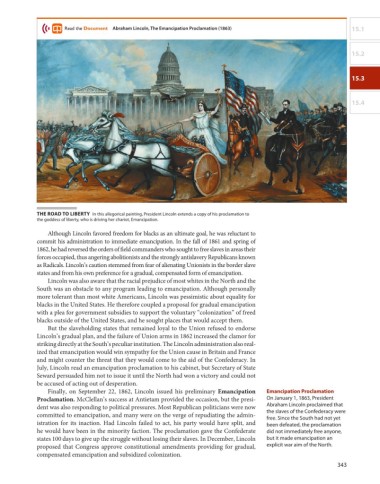
                    the road to LiBerty  In this allegorical painting, President Lincoln extends a copy of his proclamation to
                    the goddess of liberty, who is driving her chariot, emancipation.
                       Although Lincoln favored freedom for blacks as an ultimate goal, he was reluctant to
                    commit his administration to immediate emancipation. In the fall of 1861 and spring of
                    1862, he had reversed the orders of field commanders who sought to free slaves in areas their
                    forces occupied, thus angering abolitionists and the strongly antislavery Republicans known
                    as Radicals. Lincoln’s caution stemmed from fear of alienating Unionists in the border slave
                    states and from his own preference for a gradual, compensated form of emancipation.
                       Lincoln was also aware that the racial prejudice of most whites in the North and the
                    South was an obstacle to any program leading to emancipation. Although personally
                    more tolerant than most white Americans, Lincoln was pessimistic about equality for
                    blacks in the United States. He therefore coupled a proposal for gradual emancipation
                    with a plea for government subsidies to support the voluntary “colonization” of freed
                    blacks outside of the United States, and he sought places that would accept them.
                       But the slaveholding states that remained loyal to the Union refused to endorse
                    Lincoln’s gradual plan, and the failure of Union arms in 1862 increased the clamor for
                    striking directly at the South’s peculiar institution. The Lincoln administration also real-
                    ized that emancipation would win sympathy for the Union cause in  Britain and France
                    and might counter the threat that they would come to the aid of the  Confederacy. In
                    July, Lincoln read an emancipation proclamation to his cabinet, but Secretary of State
                    Seward persuaded him not to issue it until the North had won a victory and could not
                    be accused of acting out of desperation.
                       Finally, on September 22, 1862, Lincoln issued his preliminary  Emancipation   emancipation Proclamation
                    Proclamation. McClellan’s success at Antietam provided the occasion, but the presi-  On January 1, 1863, President
                    dent was also responding to political pressures. Most Republican politicians were now   Abraham Lincoln proclaimed that
                                                                                               the slaves of the Confederacy were
                    committed to emancipation, and many were on the verge of repudiating the admin-  free. Since the South had not yet
                    istration for its inaction. Had Lincoln failed to act, his party would have split, and   been defeated, the proclamation
                    he would have been in the minority faction. The proclamation gave the Confederate   did not immediately free anyone,
                    states 100 days to give up the struggle without losing their slaves. In December, Lincoln   but it made emancipation an
                    proposed that Congress approve constitutional amendments providing for gradual,   explicit war aim of the North.
                    compensated emancipation and subsidized colonization.
                                                                                                                       343

