


Page 372 - American Stories, A History of the United States
P. 372
Mobilizing the Home Fronts
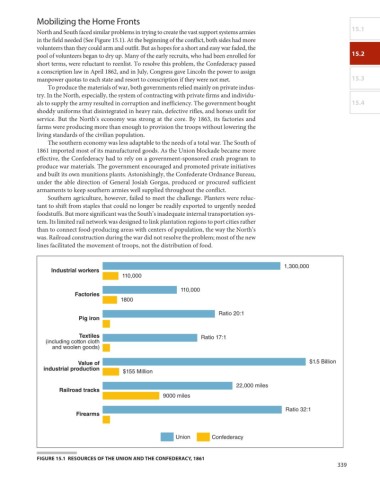
                    North and South faced similar problems in trying to create the vast support systems armies             15.1
                    in the field needed (See Figure 15.1). At the beginning of the conflict, both sides had more
                    volunteers than they could arm and outfit. But as hopes for a short and easy war faded, the
                    pool of volunteers began to dry up. Many of the early recruits, who had been enrolled for              15.2
                    short terms, were reluctant to reenlist. To resolve this problem, the Confederacy passed
                    a conscription law in April 1862, and in July, Congress gave  Lincoln the power to assign
                    manpower quotas to each state and resort to conscription if they were not met.                         15.3
                       To produce the materials of war, both governments relied mainly on private indus-
                    try. In the North, especially, the system of contracting with private firms and individu-
                    als to supply the army resulted in corruption and inefficiency. The government bought                  15.4
                    shoddy uniforms that disintegrated in heavy rain, defective rifles, and horses unfit for
                    service. But the North’s economy was strong at the core. By 1863, its factories and
                    farms were producing more than enough to provision the troops without lowering the
                    living standards of the civilian population.
                       The southern economy was less adaptable to the needs of a total war. The South of
                    1861 imported most of its manufactured goods. As the Union blockade became more
                    effective, the Confederacy had to rely on a government-sponsored crash program to
                    produce war materials. The government encouraged and promoted private initiatives
                    and built its own munitions plants. Astonishingly, the Confederate Ordnance Bureau,
                    under the able direction of General Josiah Gorgas, produced or procured sufficient
                    armaments to keep southern armies well supplied throughout the conflict.
                       Southern agriculture, however, failed to meet the challenge. Planters were reluc-
                    tant to shift from staples that could no longer be readily exported to urgently needed
                    foodstuffs. But more significant was the South’s inadequate internal transportation sys-
                    tem. Its limited rail network was designed to link plantation regions to port  cities rather
                    than to connect food-producing areas with centers of population, the way the North’s
                    was. Railroad construction during the war did not resolve the  problem; most of the new
                    lines facilitated the movement of troops, not the  distribution of food.


                                                                                                     1,300,000
                        Industrial workers
                                                110,000

                                                                   110,000
                                Factories
                                               1800

                                                                               Ratio 20:1
                                 Pig iron


                                  Textiles                                Ratio 17:1
                      (including cotton cloth
                         and woolen goods)

                                 Value of                                                                    $1.5 Billion
                      industrial production
                                                $155 Million

                                                                                     22,000 miles
                           Railroad tracks
                                                             9000 miles

                                                                                                     Ratio 32:1
                                 Firearms


                                                                 Union       Confederacy


                    fiGUre 15.1  resoUrces of the Union and the confederacy, 1861
                                                                                                                       339

