


Page 370 - American Stories, A History of the United States
P. 370
temporary disruption of commerce was better than the permanent loss of the South as
                    a market and source of raw materials.                                                                  15.1
                       In his inaugural address, Lincoln called for a cautious use of force. He would defend
                    federal forts not yet in Confederate hands but would not attempt to  recapture the
                    ones already taken. He thus tried to shift the burden for beginning hostilities to                     15.2
                    the  Confederacy, which would have to attack before it would be attacked.
                       As Lincoln spoke, U.S. forces held only four military installations within the
                    seceded states. Two in the remote Florida Keys attracted little attention. The others                  15.3
                    were Fort Pickens on an island outside Pensacola in northwest Florida and Fort  Sumter
                    inside Charleston Harbor. Attention focused on Sumter because the Confederacy,
                    egged on by South Carolina, was demanding the surrender of a garrison that was within                  15.4
                    easy reach of shore batteries and running low on supplies. Shortly after taking office,
                    Lincoln was informed that Sumter could not hold out much longer and that he would
                    have to decide whether to reinforce it or let it fall.
                       Initially, Lincoln’s cabinet opposed reinforcing or provisioning Sumter, on the
                    grounds that it was indefensible. Secretary of State Seward was so certain this would
                    be the decision that he so advised Confederate representatives. But on April 4,  Lincoln
                    ordered that the beleaguered troops in Charleston Harbor be resupplied. Two days later,
                    he notified the governor of South Carolina that a relief expedition was being sent.
                       The expedition sailed on April 8 and 9, but before it arrived, Confederate authorities
                    decided that sending supplies was a hostile act and attacked the fort. On the morning of
                    April 12, shore batteries opened fire; the bombardment continued for 40 hours without loss
                    of life but with heavy damage to the fort. Finally, on April 13, the Union forces under Major
                    Robert Anderson surrendered, and the Confederate flag was raised over Fort Sumter. The
                    South had won a victory but had also assumed responsibility for firing the first shot.
                       On April 15, Lincoln proclaimed that an insurrection against federal authority existed
                    in the Deep South and called on the militia of the loyal states to provide 75,000 troops for
                    short-term service to put it down. Two days later, a Virginia convention that had rejected
                    secession in February voted to join the Confederacy. Within five weeks, Arkansas, Ten-
                    nessee, and North Carolina followed suit. These slave states of the upper South had been
                    unwilling to secede just because Lincoln was elected, but when he called on them to pro-
                    vide troops to “coerce” other southern states, they had to choose sides. Believing that seces-
                    sion was a constitutional right, they cut their ties with a government that opted to use force
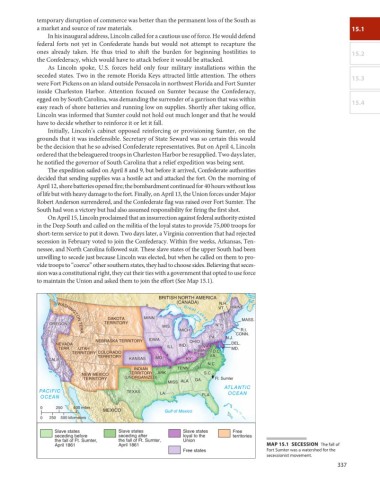
                    to maintain the Union and asked them to join the effort (See Map 15.1).


                                                            BRITISH NORTH AMERICA
                                                                  (CANADA)      N.H.
                                                                               VT.  MAINE
                                           DAKOTA      MINN.        Great Lakes        MASS.
                        OREGON            TERRITORY                           N.Y.
                                                             WIS.
                                                                   MICH.               R.I.
                                                                                     CONN.
                                                                            PA.   N.J.
                          WASHINGTON TERR.
                                       NEBRASKA TERRITORY  IOWA       OHIO
                          NEVADA                                  IND.       W.VA.  DEL.
                           TERR.  UTAH                         ILL.    (Statehood D.C.  MD.
                               TERRITORY  COLORADO                          1863)
                                        TERRITORY          MO.              VA.
                       CALIF.                     KANSAS             KY.
                                                                            N.C.
                                                    INDIAN        TENN.
                                  NEW MEXICO      TERRITORY  ARK.          S.C.
                                   TERRITORY    (UNORGANIZED)           GA.   Ft. Sumter
                                                               MISS. ALA.
                                                                                 ATLANTIC
                    PACIFIC                      TEXAS      LA.                   OCEAN
                     OCEAN                                                FLA.
                     0    250   500 miles
                                         MEXICO               Gulf of Mexico
                     0  250  500 kilometers
                         Slave states         Slave states          Slave states    Free
                         seceding before      seceding after        loyal to the    territories
                         the fall of Ft. Sumter,  the fall of Ft. Sumter,  Union
                         April 1861           April 1861                                       MaP 15.1  secession  the fall of
                                                                    Free states                Fort Sumter was a watershed for the
                                                                                               secessionist movement.
                                                                                                                       337

