


Page 367 - American Stories, A History of the United States
P. 367
15.1                                                  Read the Document     South Carolina  Declaration
                                                                                   of the Causes of Secession
                                                                                   (December 24, 1860)

            15.2


            15.3


            15.4


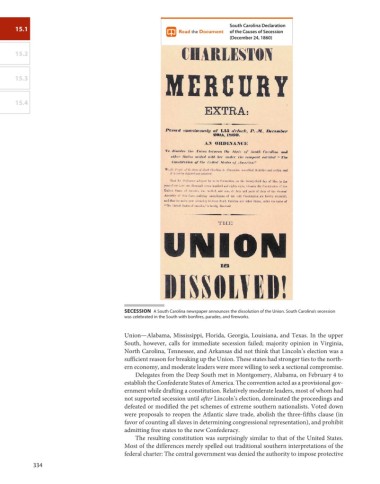
                                                secession  A South Carolina newspaper announces the dissolution of the Union. South Carolina’s secession
                                                was celebrated in the South with bonfires, parades, and fireworks.

                                                Union—Alabama, Mississippi, Florida, Georgia, Louisiana, and Texas. In the upper
                                                South, however, calls for immediate secession failed; majority opinion in Virginia,
                                                North Carolina, Tennessee, and Arkansas did not think that Lincoln’s election was a
                                                sufficient reason for breaking up the Union. These states had stronger ties to the north-
                                                ern economy, and moderate leaders were more willing to seek a sectional compromise.
                                                    Delegates from the Deep South met in Montgomery, Alabama, on February 4 to
                                                establish the Confederate States of America. The convention acted as a provisional gov-
                                                ernment while drafting a constitution. Relatively moderate leaders, most of whom had
                                                not supported secession until after Lincoln’s election, dominated the proceedings and
                                                defeated or modified the pet schemes of extreme southern nationalists. Voted down
                                                were proposals to reopen the Atlantic slave trade, abolish the three-fifths clause (in
                                                favor of counting all slaves in determining congressional representation), and prohibit
                                                admitting free states to the new Confederacy.
                                                    The resulting constitution was surprisingly similar to that of the United States.
                                                Most of the differences merely spelled out traditional southern interpretations of the
                                                federal charter: The central government was denied the authority to impose protective
                  334

