


Page 363 - American Stories, A History of the United States
P. 363
On MyHistoryLab                                                           Study and Review on MyHistoryLab


                    Chapter Review                                       Timeline


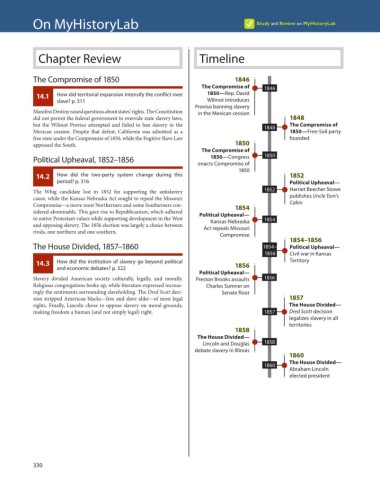
                  The Compromise of 1850                                             1846
                                                                          the Compromise of   1846
                    14.1    How did territorial expansion intensify the conflict over   1850—Rep. David
                          slave? p. 311                                     Wilmot introduces
                                                                        Proviso banning slavery
                  Manifest Destiny raised questions about states’ rights. The Constitution   in the Mexican cession
                  did not permit the federal government to override state slavery laws,                1848
                  but the Wilmot Proviso attempted and failed to ban slavery in the           1848     the Compromise of
                  Mexican  cession.  Despite  that defeat,  California was  admitted  as  a            1850—Free-Soil party
                  free state under the Compromise of 1850, while the Fugitive Slave Law                founded
                  appeased the South.                                                1850
                                                                          the Compromise of
                                                                             1850—Congress
                  Political Upheaval, 1852–1856                          enacts Compromise of   1850
                                                                                      1850
                    14.2    How did the two-party system change during this                            1852
                          period? p. 316                                                               political upheaval—
                  The Whig candidate lost in 1852 for supporting the antislavery              1852     Harriet Beecher Stowe
                  cause, while the Kansas-Nebraska Act sought to repeal the Missouri                   publishes Uncle Tom’s
                  Compromise—a move most Northerners and some Southerners con-       1854              Cabin
                  sidered abominable. This gave rise to Republicanism, which adhered   political upheaval—
                  to native Protestant values while supporting development in the West   Kansas-Nebraska   1854
                  and opposing slavery. The 1856 election was largely a choice between   Act repeals Missouri
                  rivals, one northern and one southern.
                                                                                Compromise
                                                                                                       1854–1856
                  The House Divided, 1857–1860                                                1854–    political upheaval—
                                                                                               1856    Civil war in Kansas
                    14.3    How did the institution of slavery go beyond political   1856              Territory
                          and economic debates? p. 322
                                                                         political upheaval—
                  Slavery divided American society culturally, legally, and morally.   Preston Brooks assaults   1856
                  Religious congregations broke up, while literature expressed increas-  Charles Sumner on
                  ingly the sentiments surrounding slaveholding. The Dred Scott deci-  Senate floor
                  sion stripped American blacks—free and slave alike—of most legal                     1857
                  rights. Finally, Lincoln chose to oppose slavery on moral grounds,                   the House Divided—
                  making freedom a human (and not simply legal) right.                        1857     Dred Scott decision
                                                                                                       legalizes slavery in all
                                                                                                       territories
                                                                                     1858
                                                                        the House Divided—
                                                                          Lincoln and Douglas   1858
                                                                        debate slavery in illinois
                                                                                                       1860
                                                                                                       the House Divided—
                                                                                              1860
                                                                                                       Abraham Lincoln
                                                                                                       elected president


                  330

