


Page 361 - American Stories, A History of the United States
P. 361
14.1                                                             Election of 1860
                                                                   Electoral Vote by State        Popular Vote
                                                                         REPUBLICAN
            14.2                                                        Abraham Lincoln  180        1,865,593

                                                               DEMOCRATIC, SOUTHERN
                                                                     John C. Breckinridge  72         848,356
            14.3                                               DEMOCRATIC, NORTHERN
                                                                     Stephen A. Douglas  12         1,382,713
                                                                CONSTITUTIONAL UNION   39             592,906
                                                                             John Bell
                                                                                       303          4,689,568


                                                                                                             8
                                                                WASH.
                                                                                                          5
                                                                                      4                    5  13
                                                              3          NEBRASKA                       35
                                                                       TERR.   UNORG. TERR.   5
                                                                          TERR.                6              6 4
                                                                                       4              27    4
                                                                   UTAH                       13  23        3
                                                                   TERR.                   11        15      3
                                                                               KANSAS
                                                             4                 TERR.    9       12           8
                                                                                               12     10
                                                                    NEW MEXICO    INDIAN  4          8
                                                                      TERR.       TERR.           10
                                                                                            7  9
                                                                                 4       6
                                                                                                      3


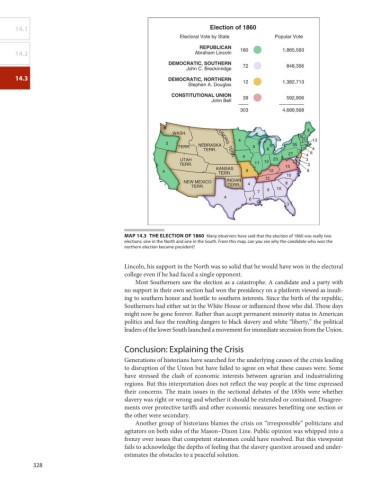
                                                MAp 14.3  tHe eLeCtioN oF 1860  Many observers have said that the election of 1860 was really two
                                                elections: one in the North and one in the South. From this map, can you see why the candidate who won the
                                                northern election became president?


                                                Lincoln, his support in the North was so solid that he would have won in the electoral
                                                college even if he had faced a single opponent.
                                                    Most Southerners saw the election as a catastrophe. A candidate and a party with
                                                no support in their own section had won the presidency on a platform viewed as insult-
                                                ing to southern honor and hostile to southern interests. Since the birth of the republic,
                                                  Southerners had either sat in the White House or influenced those who did. Those days
                                                might now be gone forever. Rather than accept permanent minority status in American
                                                politics and face the resulting dangers to black slavery and white “liberty,” the political
                                                leaders of the lower South launched a movement for immediate secession from the Union.


                                                Conclusion: explaining the Crisis

                                                Generations of historians have searched for the underlying causes of the crisis leading
                                                to disruption of the Union but have failed to agree on what these causes were. Some
                                                have  stressed the  clash of  economic interests  between  agrarian  and industrializing
                                                regions. But this interpretation does not reflect the way people at the time expressed
                                                their concerns. The main issues in the sectional debates of the 1850s were whether
                                                slavery was right or wrong and whether it should be extended or contained. Disagree-
                                                ments over protective tariffs and other economic measures benefiting one section or
                                                the other were secondary.
                                                    Another group of historians blames the crisis on “irresponsible” politicians and
                                                agitators on both sides of the Mason–Dixon Line. Public opinion was whipped into a
                                                frenzy over issues that competent statesmen could have resolved. But this viewpoint
                                                fails to acknowledge the depths of feeling that the slavery question aroused and under-
                                                estimates the obstacles to a peaceful solution.
                  328

