


Page 357 - American Stories, A History of the United States
P. 357
14.1                                      Watch the Video  dred Scott and the Crises that Led to the Civil War


            14.2


            14.3


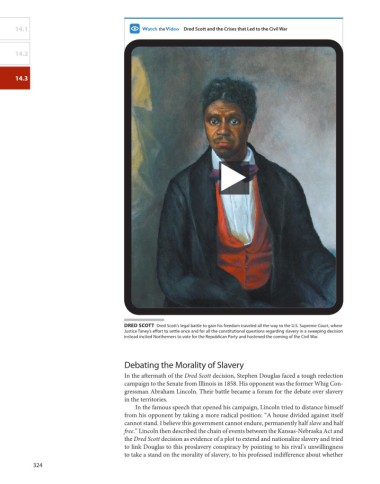
                                                DreD sCott  Dred Scott’s legal battle to gain his freedom traveled all the way to the U.S. Supreme Court, where
                                                justice Taney’s effort to settle once and for all the constitutional questions regarding slavery in a sweeping decision
                                                instead incited Northerners to vote for the Republican Party and hastened the coming of the Civil War.


                                                Debating the Morality of Slavery

                                                In the aftermath of the Dred Scott decision, Stephen Douglas faced a tough reelection
                                                campaign to the Senate from Illinois in 1858. His opponent was the former Whig Con-
                                                gressman Abraham Lincoln. Their battle became a forum for the debate over slavery
                                                in the territories.
                                                    In the famous speech that opened his campaign, Lincoln tried to distance himself
                                                from his opponent by taking a more radical position: “A house divided against itself
                                                cannot stand. I believe this government cannot endure, permanently half slave and half
                                                free.” Lincoln then described the chain of events between the Kansas-Nebraska Act and
                                                the Dred Scott decision as evidence of a plot to extend and nationalize slavery and tried
                                                to link Douglas to this proslavery conspiracy by pointing to his rival’s unwillingness
                                                to take a stand on the morality of slavery, to his professed indifference about whether
                  324

