


Page 355 - American Stories, A History of the United States
P. 355
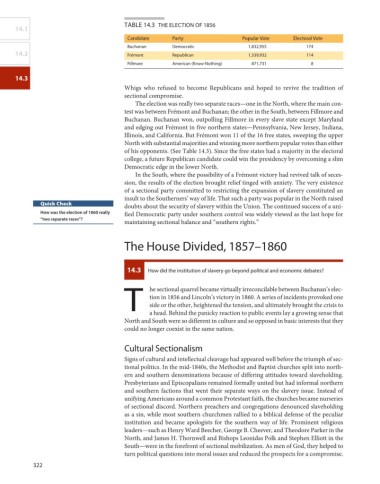
TABLe 14.3  THe eLeCTiON OF 1856
            14.1
                                                 Candidate      Party                  Popular vote     electoral vote
                                                 Buchanan       Democratic               1,832,955          174
            14.2                                 Frémont        Republican               1,339,932          114

                                                 Fillmore       American (Know-Nothing)   871,731             8

            14.3
                                                Whigs who refused to become Republicans and hoped to revive the tradition of
                                                  sectional compromise.
                                                    The election was really two separate races—one in the North, where the main con-
                                                test was between Frémont and Buchanan; the other in the South, between  Fillmore and
                                                Buchanan. Buchanan won, outpolling Fillmore in every slave state except Maryland
                                                and edging out Frémont in five northern states—Pennsylvania, New Jersey, Indiana,
                                                Illinois, and California. But Frémont won 11 of the 16 free states, sweeping the upper
                                                North with substantial majorities and winning more northern popular votes than either
                                                of his opponents. (See Table 14.3). Since the free states had a majority in the electoral
                                                college, a future Republican candidate could win the presidency by overcoming a slim
                                                Democratic edge in the lower North.
                                                    In the South, where the possibility of a Frémont victory had revived talk of seces-
                                                sion, the results of the election brought relief tinged with anxiety. The very existence
                                                of a sectional party committed to restricting the expansion of slavery constituted an
                                                insult to the Southerners’ way of life. That such a party was popular in the North raised
                     Quick Check                doubts about the security of slavery within the Union. The continued success of a uni-
                     How was the election of 1860 really   fied Democratic party under southern control was widely viewed as the last hope for
                     “two separate races”?
                                                maintaining sectional balance and “southern rights.”

                                                The House Divided, 1857–1860


                                                  14.3   How did the institution of slavery go beyond political and economic debates?

                                                T        he sectional quarrel became virtually irreconcilable between Buchanan’s elec-
                                                         tion in 1856 and Lincoln’s victory in 1860. A series of incidents provoked one
                                                         side or the other, heightened the tension, and ultimately brought the crisis to
                                                         a head. Behind the panicky reaction to public events lay a growing sense that
                                                North and South were so different in culture and so opposed in basic interests that they
                                                could no longer coexist in the same nation.


                                                Cultural Sectionalism
                                                Signs of cultural and intellectual cleavage had appeared well before the triumph of sec-
                                                tional politics. In the mid-1840s, the Methodist and Baptist churches split into north-
                                                ern and southern denominations because of differing attitudes toward slaveholding.
                                                Presbyterians and Episcopalians remained formally united but had informal northern
                                                and southern factions that went their separate ways on the slavery issue. Instead of
                                                unifying Americans around a common Protestant faith, the churches became nurseries
                                                of sectional discord. Northern preachers and congregations denounced slaveholding
                                                as a sin, while most southern churchmen rallied to a biblical defense of the peculiar
                                                institution and became apologists for the southern way of life. Prominent religious
                                                leaders—such as Henry Ward Beecher, George B. Cheever, and Theodore Parker in the
                                                North, and James H. Thornwell and Bishops Leonidas Polk and Stephen Elliott in the
                                                South—were in the forefront of sectional mobilization. As men of God, they helped to
                                                turn political questions into moral issues and reduced the prospects for a compromise.
                  322

