


Page 351 - American Stories, A History of the United States
P. 351
14.1                                               Read the Document   Massachusetts defies the Fugitive Slave
                                                                              Act (1855)


            14.2


            14.3


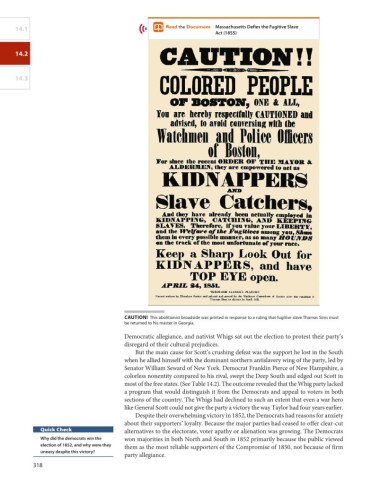
                                                CAutioN!  This abolitionist broadside was printed in response to a ruling that fugitive slave Thomas Sims must
                                                be returned to his master in Georgia.

                                                Democratic allegiance, and nativist Whigs sat out the election to protest their party’s
                                                disregard of their cultural prejudices.
                                                    But the main cause for Scott’s crushing defeat was the support he lost in the South
                                                when he allied himself with the dominant northern antislavery wing of the party, led by
                                                Senator William Seward of New York. Democrat Franklin Pierce of New Hampshire, a
                                                colorless nonentity compared to his rival, swept the Deep South and edged out Scott in
                                                most of the free states. (See Table 14.2). The outcome revealed that the Whig party lacked
                                                a program that would distinguish it from the Democrats and appeal to voters in both
                                                sections of the country. The Whigs had declined to such an extent that even a war hero
                                                like General Scott could not give the party a victory the way Taylor had four years earlier.
                                                    Despite their overwhelming victory in 1852, the Democrats had reasons for anxiety
                                                about their supporters’ loyalty. Because the major parties had ceased to offer clear-cut
                     Quick Check                alternatives to the electorate, voter apathy or alienation was growing. The Democrats
                     Why did the democrats win the   won majorities in both North and South in 1852 primarily because the public viewed
                     election of 1852, and why were they   them as the most reliable supporters of the Compromise of 1850, not because of firm
                     uneasy despite this victory?
                                                party allegiance.
                  318

