


Page 348 - American Stories, A History of the United States
P. 348
Read the Document  Henry Clay and John Calhoun, The Compromise of 1850                          14.1


                                                                                                                           14.2


                                                                                                                           14.3


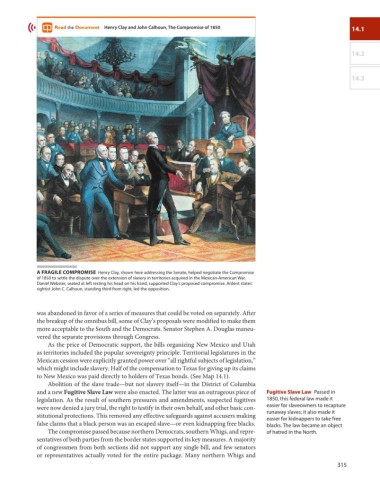
                    A FrAgiLe CoMproMise  Henry Clay, shown here addressing the Senate, helped negotiate the Compromise
                    of 1850 to settle the dispute over the extension of slavery in territories acquired in the Mexican-American War.
                    Daniel Webster, seated at left resting his head on his hand, supported Clay’s proposed compromise. Ardent states’
                    rightist john C. Calhoun, standing third from right, led the opposition.


                    was abandoned in favor of a series of measures that could be voted on separately. After
                    the breakup of the omnibus bill, some of Clay’s proposals were modified to make them
                    more acceptable to the South and the Democrats. Senator Stephen A. Douglas maneu-
                    vered the separate provisions through Congress.
                       As the price of Democratic support, the bills organizing New Mexico and Utah
                    as territories included the popular sovereignty principle. Territorial legislatures in the
                    Mexican cession were explicitly granted power over “all rightful subjects of legislation,”
                    which might include slavery. Half of the compensation to Texas for giving up its claims
                    to New Mexico was paid directly to holders of Texas bonds. (See Map 14.1).
                       Abolition of the slave trade—but not slavery itself—in the District of Columbia
                    and a new Fugitive Slave Law were also enacted. The latter was an outrageous piece of   Fugitive slave Law  Passed in
                    legislation. As the result of southern pressures and amendments, suspected fugitives   1850, this federal law made it
                    were now denied a jury trial, the right to testify in their own behalf, and other basic con-  easier for slaveowners to recapture
                    stitutional protections. This removed any effective safeguards against accusers making   runaway slaves; it also made it
                                                                                               easier for kidnappers to take free
                    false claims that a black person was an escaped slave—or even kidnapping free blacks.  blacks. The law became an object
                       The compromise passed because northern Democrats, southern Whigs, and repre-  of hatred in the North.
                    sentatives of both parties from the border states supported its key measures. A majority
                    of congressmen from both sections did not support any single bill, and few senators
                    or representatives actually voted for the entire package. Many northern Whigs and
                                                                                                                       315

