


Page 347 - American Stories, A History of the United States
P. 347
14.1


            14.2


            14.3


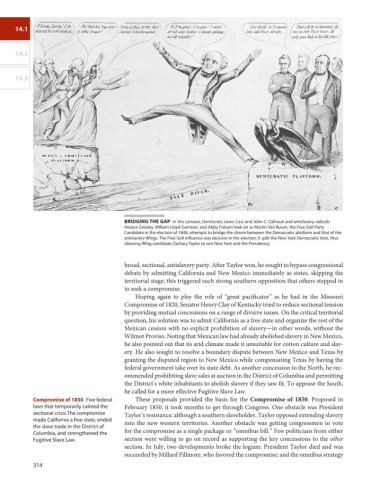
                                                briDgiNg tHe gAp  in this cartoon, Democrats Lewis Cass and john C. Calhoun and antislavery radicals
                                                Horace Greeley, William Lloyd Garrison, and Abby Folsom look on as Martin van Buren, the Free-Soil Party
                                                Candidate in the election of 1848, attempts to bridge the chasm between the Democratic platform and that of the
                                                antislavery Whigs. The Free-Soil influence was decisive in the election; it split the New York Democratic vote, thus
                                                allowing Whig candidate Zachary Taylor to win New York and the Presidency.


                                                broad, sectional, antislavery party. After Taylor won, he sought to bypass congressional
                                                debate by admitting California and New Mexico immediately as states, skipping the
                                                territorial stage; this triggered such strong southern opposition that others stepped in
                                                to seek a compromise.
                                                    Hoping again to play the role of “great pacificator” as he had in the Missouri
                                                  Compromise of 1820, Senator Henry Clay of Kentucky tried to reduce sectional  tension
                                                by providing mutual concessions on a range of divisive issues. On the critical territorial
                                                question, his solution was to admit California as a free state and organize the rest of the
                                                Mexican cession with no explicit prohibition of slavery—in other words, without the
                                                Wilmot Proviso. Noting that Mexican law had already abolished slavery in New Mexico,
                                                he also pointed out that its arid climate made it unsuitable for cotton culture and slav-
                                                ery. He also sought to resolve a boundary dispute between New Mexico and Texas by
                                                granting the disputed region to New Mexico while compensating Texas by having the
                                                federal government take over its state debt. As another concession to the North, he rec-
                                                ommended prohibiting slave sales at auction in the District of Columbia and permitting
                                                the District’s white inhabitants to abolish slavery if they saw fit. To appease the South,
                                                he called for a more effective Fugitive Slave Law.
                  Compromise of 1850  Five federal   These proposals provided the basis for the Compromise of 1850. Proposed in
                  laws that temporarily calmed the   February 1850, it took months to get through Congress. One obstacle was President
                  sectional crisis.The compromise   Taylor’s resistance; although a southern slaveholder, Taylor opposed extending slavery
                  made California a free state, ended
                  the slave trade in the District of   into the new western territories. Another obstacle was getting congressmen to vote
                  Columbia, and strengthened the   for the compromise as a single package or “omnibus bill.” Few politicians from either
                  Fugitive Slave Law.           section were willing to go on record as supporting the key concessions to the other
                                                section. In July, two developments broke the logjam: President Taylor died and was
                                                succeeded by Millard Fillmore, who favored the compromise; and the omnibus strategy
                  314

