


Page 349 - American Stories, A History of the United States
P. 349
BRITISH NORTH AMERICA
            14.1                                                                                (CANADA)     N.H.
                                                                                                             VT.  ME.
                                                       OREGON                   MINNESOTA        Great Lakes
                                                      TERRITORY                 TERRITORY
                                                         1848                     1849                              MASS.
            14.2                                                                          WIS.              N.Y.
                                                                                                                    R.I.
                                                                                                MICH.              CONN.
                                                                       UNORGANIZED                        PA.  N.J.
                                                                        TERRITORY     IOWA
                                                             UTAH                               IND.  OHIO       DEL.
            14.3                                           TERRITORY                        ILL.         VA.     MD.
                                                             1850
                                                 CALIFORNIA                             MO.       KY.
                                                    1850                                                  N.C.
                                                               NEW MEXICO        INDIAN        TENN.
                                                                TERRITORY       TERRITORY ARK.           S.C.
                                                                  1850                                GA.      ATLANTIC
                                                                                            MISS. ALA.
                                                                                                                OCEAN
                                                 PACIFIC                       TEXAS     LA.
                                                  OCEAN
                                                                  MEXICO                                 FLA.
                                                                                           Gulf of Mexico
                                                       Free state or territory
                                                                                      0    250   500 miles
                                                       Slave state or territory
                                                       Opened to slavery by principle  0  250  500 kilometers
                                                       of popular sovereignty

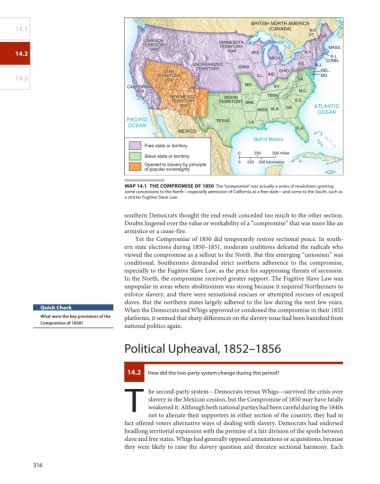
                                                 MAp 14.1  tHe CoMproMise oF 1850  The “compromise” was actually a series of resolutions granting
                                                 some concessions to the North—especially admission of California as a free state—and some to the South, such as
                                                 a stricter Fugitive Slave Law.


                                                southern Democrats thought the end result conceded too much to the other section.
                                                Doubts lingered over the value or workability of a “compromise” that was more like an
                                                armistice or a cease-fire.
                                                    Yet the Compromise of 1850 did temporarily restore sectional peace. In south-
                                                ern state elections during 1850–1851, moderate coalitions defeated the radicals who
                                                viewed the compromise as a sellout to the North. But this emerging “unionism” was
                                                conditional. Southerners  demanded  strict northern adherence  to the  compromise,
                                                especially to the Fugitive Slave Law, as the price for suppressing threats of secession.
                                                In the North, the compromise received greater support. The Fugitive Slave Law was
                                                unpopular in areas where abolitionism was strong because it required Northerners to
                                                enforce slavery, and there were sensational rescues or attempted rescues of escaped
                                                slaves. But the northern states largely adhered to the law during the next few years.
                     Quick Check                When the Democrats and Whigs approved or condoned the compromise in their 1852
                     What were the key provisions of the   platforms, it seemed that sharp differences on the slavery issue had been banished from
                     Compromise of 1850?
                                                national politics again.

                                                Political Upheaval, 1852–1856


                                                  14.2   How did the two-party system change during this period?
                                                 T      he second-party system—Democrats versus Whigs—survived the crisis over


                                                        slavery in the Mexican cession, but the Compromise of 1850 may have fatally
                                                        weakened it. Although both national parties had been careful during the 1840s
                                                        not to alienate their supporters in either section of the country, they had in
                                                fact offered voters alternative ways of dealing with slavery. Democrats had endorsed
                                                headlong territorial expansion with the promise of a fair division of the spoils between
                                                slave and free states. Whigs had generally opposed annexations or acquisitions, because
                                                they were likely to raise the slavery question and threaten sectional harmony. Each


                  316

