


Page 353 - American Stories, A History of the United States
P. 353
BRITISH NORTH AMERICA
            14.1                                                                               (CANADA)      N.H.
                                                                                                             VT.

                                                    OREGON                      MINNESOTA                           MASS.
                                                                                                 Great Lakes
            14.2                                   TERRITORY          NEBRASKA  TERRITORY  WIS.            N.Y.
                                                                      TERRITORY                 MICH.               R.I.
                                                                        1854                              PA.     CONN.
                                                        WASHINGTON TERR.
                                                                                      IOWA         OHIO Mason and   N.J.
                                                              UTAH                          ILL.  IND.  Dixon Line   DEL.
                                                                                                                 MD.
            14.3                                            TERRITORY
                                                                         KANSAS TERRITORY                VA.
                                                  CALIFORNIA                  1854       MO.      KY.
                                                                            Missouri Compromise Line     N.C.
                                                                                      36°30'   TENN.
                                                                NEW MEXICO       INDIAN                 S.C.
                                                                 TERRITORY      TERRITORY  ARK.      GA.
                                                                                            MISS.  ALA.
                                                 PACIFIC                       TEXAS     LA.                  ATLANTIC
                                                  OCEAN                                                        OCEAN
                                                                                                        FLA.
                                                 0    250   500 miles
                                                 0  250  500 kilometers                   Gulf of Mexico
                                                                       MEXICO
                                                                              Opened to slavery by principle of popular
                                                       Free state or territory
                                                                              sovereignty, Compromise of 1850
                                                       Slave state or territory  Opened to slavery by principle of popular
                                                                              sovereignty, Kansas-Nebraska Act of 1854
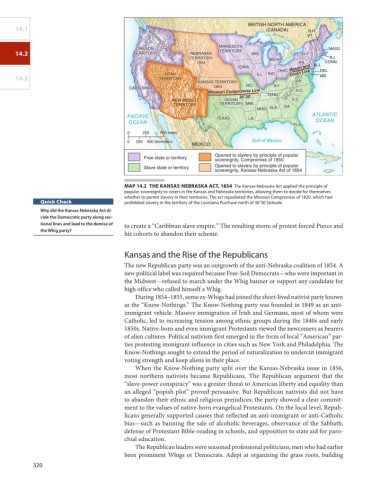
                                                MAp 14.2  tHe KANsAs-NebrAsKA ACt, 1854  The Kansas-Nebraska Act applied the principle of
                                                popular sovereignty to voters in the Kansas and Nebraska territories, allowing them to decide for themselves
                                                whether to permit slavery in their territories. The act repudiated the Missouri Compromise of 1820, which had
                     Quick Check                prohibited slavery in the territory of the Louisiana Purchase north of 36°30’ latitude.
                     Why did the Kansas Nebraska Act di-
                     vide the democratic party along sec-
                     tional lines and lead to the demise of   to create a “Caribbean slave empire.” The resulting storm of protest forced Pierce and
                     the Whig party?
                                                his cohorts to abandon their scheme.


                                                Kansas and the Rise of the Republicans
                                                The new Republican party was an outgrowth of the anti-Nebraska coalition of 1854. A
                                                new political label was required because Free-Soil Democrats—who were important in
                                                the Midwest—refused to march under the Whig banner or support any candidate for
                                                high office who called himself a Whig.
                                                    During 1854–1855, some ex-Whigs had joined the short-lived nativist party known
                                                as the “Know-Nothings.” The Know-Nothing party was founded in 1849 as an anti-
                                                immigrant vehicle. Massive immigration of Irish and Germans, most of whom were
                                                Catholic, led to increasing tension among ethnic groups during the 1840s and early
                                                1850s. Native-born and even immigrant Protestants viewed the newcomers as bearers
                                                of alien cultures. Political nativism first emerged in the form of local “American” par-
                                                ties protesting immigrant influence in cities such as New York and Philadelphia. The
                                                Know-Nothings sought to extend the period of naturalization to undercut immigrant
                                                voting strength and keep aliens in their place.
                                                    When the Know-Nothing party split over the Kansas-Nebraska issue in 1856,
                                                most northern nativists became Republicans. The Republican argument that the
                                                “slave-power conspiracy” was a greater threat to American liberty and equality than
                                                an alleged “popish plot” proved persuasive. But Republican nativists did not have
                                                to abandon their ethnic and religious prejudices; the party showed a clear commit-
                                                ment to the values of native-born evangelical Protestants. On the local level, Repub-
                                                licans generally supported causes that reflected an anti-immigrant or anti-Catholic
                                                bias—such as banning the sale of alcoholic beverages, observance of the Sabbath,
                                                defense of Protestant Bible-reading in schools, and opposition to state aid for paro-
                                                chial education.
                                                    The Republican leaders were seasoned professional politicians, men who had  earlier
                                                been prominent Whigs or Democrats. Adept at organizing the grass roots, building
                  320

