


Page 350 - American Stories, A History of the United States
P. 350
Read the Document  The Fugitive Slave Act (1850)                                                14.1


                                                                                                                           14.2


                                                                                                                           14.3


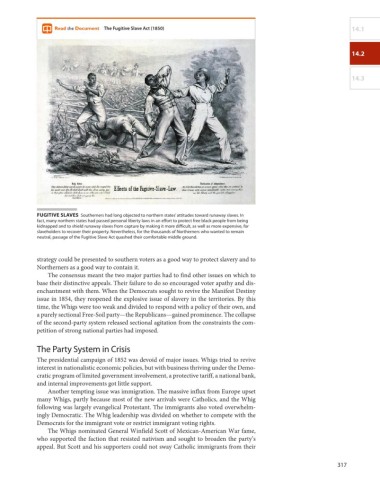
                    Fugitive sLAves  Southerners had long objected to northern states’ attitudes toward runaway slaves. in
                    fact, many northern states had passed personal liberty laws in an effort to protect free black people from being
                    kidnapped and to shield runaway slaves from capture by making it more difficult, as well as more expensive, for
                    slaveholders to recover their property. Nevertheless, for the thousands of Northerners who wanted to remain
                    neutral, passage of the Fugitive Slave Act quashed their comfortable middle ground.


                    strategy could be presented to southern voters as a good way to protect slavery and to
                    Northerners as a good way to contain it.
                       The consensus meant the two major parties had to find other issues on which to
                    base their distinctive appeals. Their failure to do so encouraged voter apathy and dis-
                    enchantment with them. When the Democrats sought to revive the Manifest Destiny
                    issue in 1854, they reopened the explosive issue of slavery in the territories. By this
                    time, the Whigs were too weak and divided to respond with a policy of their own, and
                    a purely sectional Free-Soil party—the Republicans—gained prominence. The collapse
                    of the second-party system released sectional agitation from the constraints the com-
                    petition of strong national parties had imposed.


                    The Party System in Crisis
                    The presidential campaign of 1852 was devoid of major issues. Whigs tried to revive
                    interest in nationalistic economic policies, but with business thriving under the Demo-
                    cratic program of limited government involvement, a protective tariff, a national bank,
                    and internal improvements got little support.
                       Another tempting issue was immigration. The massive influx from Europe upset
                    many Whigs, partly because most of the new arrivals were Catholics, and the Whig
                    following was largely evangelical Protestant. The immigrants also voted overwhelm-
                    ingly Democratic. The Whig leadership was divided on whether to compete with the
                    Democrats for the immigrant vote or restrict immigrant voting rights.
                       The Whigs nominated General Winfield Scott of Mexican-American War fame,
                    who supported the faction that resisted nativism and sought to broaden the party’s
                    appeal. But Scott and his supporters could not sway Catholic immigrants from their


                                                                                                                       317

