


Page 352 - American Stories, A History of the United States
P. 352
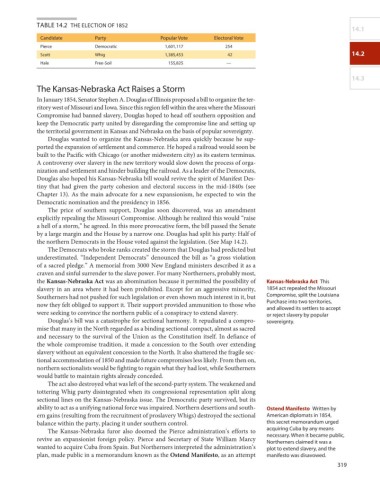
TABLe 14.2  THe eLeCTiON OF 1852
                                                                                                                           14.1
                     Candidate         Party                Popular vote      electoral vote
                     Pierce            Democratic             1,601,117           254
                     Scott             Whig                   1,385,453             42                                     14.2
                     Hale              Free-Soil               155,825            —

                                                                                                                           14.3
                    The Kansas-Nebraska Act Raises a Storm

                    In January 1854, Senator Stephen A. Douglas of Illinois proposed a bill to organize the ter-
                    ritory west of Missouri and Iowa. Since this region fell within the area where the  Missouri
                    Compromise had banned slavery, Douglas hoped to head off southern opposition and
                    keep the Democratic party united by disregarding the compromise line and setting up
                    the territorial government in Kansas and Nebraska on the basis of popular sovereignty.
                       Douglas wanted to organize the Kansas-Nebraska area quickly because he sup-
                    ported the expansion of settlement and commerce. He hoped a railroad would soon be
                    built to the Pacific with Chicago (or another midwestern city) as its eastern terminus.
                    A controversy over slavery in the new territory would slow down the process of orga-
                    nization and settlement and hinder building the railroad. As a leader of the  Democrats,
                    Douglas also hoped his Kansas-Nebraska bill would revive the spirit of Manifest Des-
                    tiny that had given the party cohesion and electoral success in the  mid-1840s (see
                    Chapter 13). As the main advocate for a new expansionism, he expected to win the
                    Democratic nomination and the presidency in 1856.
                       The  price  of  southern  support,  Douglas  soon  discovered,  was  an  amendment
                    explicitly repealing the Missouri Compromise. Although he realized this would “raise
                    a hell of a storm,” he agreed. In this more provocative form, the bill passed the Senate
                    by a large margin and the House by a narrow one. Douglas had split his party: Half of
                    the northern Democrats in the House voted against the legislation. (See Map 14.2).
                       The Democrats who broke ranks created the storm that Douglas had predicted but
                    underestimated. “Independent Democrats” denounced the bill as “a gross violation
                    of a sacred pledge.” A memorial from 3000 New England ministers described it as a
                    craven and sinful surrender to the slave power. For many Northerners, probably most,
                    the Kansas-Nebraska Act was an abomination because it permitted the possibility of   Kansas-Nebraska Act  This
                    slavery in an area where it had been prohibited. Except for an aggressive minority,   1854 act repealed the Missouri
                    Southerners had not pushed for such legislation or even shown much interest in it, but   Compromise, split the Louisiana
                    now they felt obliged to support it. Their support provided ammunition to those who   Purchase into two territories,
                                                                                               and allowed its settlers to accept
                    were seeking to convince the northern public of a conspiracy to extend slavery.  or reject slavery by popular
                       Douglas’s bill was a catastrophe for sectional harmony. It repudiated a compro-  sovereignty.
                    mise that many in the North regarded as a binding sectional compact, almost as sacred
                    and necessary to the survival of the Union as the Constitution itself. In defiance of
                    the whole compromise tradition, it made a concession to the South over extending
                    slavery without an equivalent concession to the North. It also shattered the fragile sec-
                    tional accommodation of 1850 and made future compromises less likely. From then on,
                    northern sectionalists would be fighting to regain what they had lost, while Southerners
                    would battle to maintain rights already conceded.
                       The act also destroyed what was left of the second-party system. The weakened and
                    tottering Whig party disintegrated when its congressional representation split along
                    sectional lines on the Kansas-Nebraska issue. The Democratic party survived, but its
                    ability to act as a unifying national force was impaired. Northern desertions and south-  ostend Manifesto  Written by
                    ern gains (resulting from the recruitment of proslavery Whigs) destroyed the sectional   American diplomats in 1854,
                    balance within the party, placing it under southern control.               this secret memorandum urged
                       The Kansas-Nebraska furor also doomed the Pierce administration’s efforts to   acquiring Cuba by any means
                    revive an expansionist foreign policy. Pierce and Secretary of State William Marcy   necessary. When it became public,
                                                                                               Northerners claimed it was a
                    wanted to acquire Cuba from Spain. But Northerners interpreted the administration’s   plot to extend slavery, and the
                    plan, made public in a memorandum known as the Ostend Manifesto, as an attempt   manifesto was disavowed.
                                                                                                                       319

