


Page 345 - American Stories, A History of the United States
P. 345
Explore the
            14.1

                         Sectional Crisis on
            14.2
                         MyHistoryLab


            14.3
                    HoW DiD tHe NAtioN
                    iNCreAsiNgLy FrACture
                    DuriNg tHe seCtioNAL
                    Crisis?


                    Between 1790 and 1860, the ever-
                    expanding United States saw
                    dramatic changes in its population.
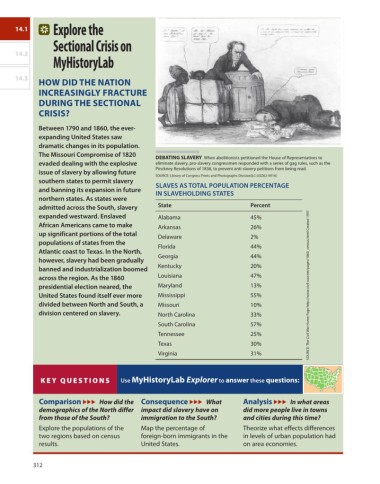
                    The Missouri Compromise of 1820        DebAtiNg sLAvery  When abolitionists petitioned the House of Representatives to
                    evaded dealing with the explosive      eliminate slavery, pro-slavery congressmen responded with a series of gag rules, such as the
                    issue of slavery by allowing future    Pinckney Resolutions of 1836, to prevent anti-slavery petitions from being read.
                                                           SOURCe: Library of Congress Prints and Photographs Division[LC-USZ62-9916]
                    southern states to permit slavery      SLAvES AS ToTAL PoPULATIoN PErCENTAgE
                    and banning its expansion in future    IN SLAvEHoLdINg STATES
                    northern states. As states were
                    admitted across the South, slavery     State                          Percent
                    expanded westward. Enslaved            Alabama                        45%
                    African Americans came to make         Arkansas                       26%
                    up significant portions of the total   Delaware                       2%
                    populations of states from the         Florida                        44%
                    Atlantic coast to Texas. In the North,   Georgia                      44%
                    however, slavery had been gradually
                    banned and industrialization boomed    Kentucky                       20%
                    across the region. As the 1860         Louisiana                      47%
                    presidential election neared, the      Maryland                       13%                SOURCe: The Civil War Home Page http://www.civil-war.net/pages/1860_census.html Created 1997.
                    United States found itself ever more   Mississippi                    55%
                    divided between North and South, a     Missouri                       10%
                    division centered on slavery.          North Carolina                 33%
                                                           South Carolina                 57%
                                                           Tennessee                      25%
                                                           Texas                          30%
                                                           virginia                       31%


                     K e y  Q u e S t i O n S  Use MyHistoryLab Explorer to answer these questions:


                    Comparison           How did the  Consequence           What        Analysis        In what areas
                    demographics of the North differ  impact did slavery have on       did more people live in towns
                    from those of the South?          immigration to the South?        and cities during this time?

                    explore the populations of the    Map the percentage of            Theorize what effects differences
                    two regions based on census       foreign-born immigrants in the   in levels of urban population had
                    results.                          United States.                   on area economies.


                  312

