


Page 346 - American Stories, A History of the United States
P. 346
The tradition of providing both the free North and the slave South with opportu-
                    nities to expand and create new states broke down when new territories were wrested   Quick Check      14.1
                    from Mexico in the 1840s. The acquisition of Texas, California, and New Mexico—all   What role did the Constitution
                    south of the Missouri Compromise line—threatened to upset the parity between slave   play in the debates over slavery in
                    and free states. Since it was generally assumed in the North that Congress could pro-  existing states as well as in newly   14.2
                    hibit slavery in new territories, a movement developed in Congress to do just that.  acquired territories?

                    The Wilmot Proviso Launches the Free-Soil Movement                                                     14.3

                    The Free-Soil crusade began in August 1846, only three months after the start of the
                    Mexican-American War, when Representative David Wilmot, a Pennsylvania  Democrat,
                    proposed an amendment to the military appropriations bill that would ban slavery in any
                    territory acquired from Mexico. Wilmot spoke for the many northern Democrats who
                    felt neglected and betrayed by the party’s choice of Polk over Van Buren in 1844 and by
                    Polk’s “prosouthern” policies. Wilmot also proposed prohibiting free African Americans
                    from settling in the new territories. This would enhance the economic opportunities of
                    the North’s common folk by preventing competition from slaves and free blacks. By
                    thus linking racism with resistance to the spread of slavery, Wilmot appealed to a broad
                    spectrum of northern opinion.
                       Northern Whigs shared Wilmot’s concern about unregulated competition between
                    slave and free labor in the territories. Voting for the measure also provided an outlet   Wilmot proviso  in 1846, shortly
                    for their frustration at being unable to halt the annexation of Texas and the Mexican-  after the outbreak of the Mexican-
                    American War. Whig leaders preferred that there be no expansion at all, but when   American War, Congressman David
                    expansion could not be avoided, northern Whigs endorsed the view that territory   Wilmot of Pennsylvania introduced
                                                                                               this amendment banning slavery
                    acquired from Mexico should not be used to increase the power of the slave states.  in any lands won from Mexico.
                       In the first House vote on the Wilmot Proviso, a sectional cleavage replaced party
                    lines. Every northern congressman except for two Democrats voted for the amend-
                    ment, and every Southerner except two Whigs voted against it. After passing the
                    House, the Proviso was blocked in the Senate by a combination of southern influence   Quick Check
                    and Democratic loyalty to the administration. When the appropriations bill went back   What was the Wilmot Proviso, and
                    to the House without the Proviso, the administration’s arm-twisting changed enough   what effect did it have on existing
                    northern Democratic votes to pass the bill and thus defeat the Proviso.       party lines?

                    Forging a Compromise

                    One early compromise reached on the Mexican cession was a formula known as
                    “squatter sovereignty” that would enable the actual settlers to determine the status
                    of slavery in a territory. The North and the South interpreted this proposal differ-
                    ently. For northern Democrats, squatter sovereignty—or popular sovereignty, as it   popular sovereignty  The
                    was later called—meant the settlers could vote slavery up or down at the first meeting   concept that the settlers of a newly
                    of a territorial legislature. For the southern wing of the party, it meant a decision would   organized territory had the right to
                    be made only when a convention drew up a constitution and applied for statehood.   decide (through voting) whether
                                                                                               to accept slavery.
                    The chief proponent of squatter sovereignty was Senator Lewis Cass of Michigan, the
                    Democratic nominee for president in 1848. Cass lost to General Zachary Taylor, who
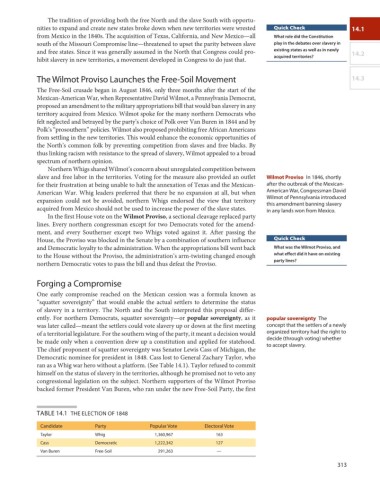
                    ran as a Whig war hero without a platform. (See Table 14.1). Taylor refused to commit
                    himself on the status of slavery in the territories, although he promised not to veto any
                    congressional legislation on the subject. Northern supporters of the Wilmot Proviso
                    backed former President Van Buren, who ran under the new Free-Soil Party, the first


                    TABLe 14.1  THe eLeCTiON OF 1848
                     Candidate         Party             Popular vote      electoral vote
                     Taylor            Whig               1,360,967            163
                     Cass              Democratic         1,222,342            127
                     van Buren         Free-Soil           291,263             —

                                                                                                                       313

