


Page 358 - American Stories, A History of the United States
P. 358
slavery was voted up or down in the territories. For Lincoln, the only security against
                    the triumph of slavery and the slave power was moral opposition to human bondage.                      14.1
                       In the series of debates that focused national attention on the Illinois contest,
                    Lincoln hammered away at the theme that Douglas was a covert defender of slavery
                    because he was not a principled opponent of it. Douglas accused Lincoln of endanger-                   14.2
                    ing the Union by his talk of putting slavery on the path to extinction. Denying that
                    he was an abolitionist, Lincoln distinguished between tolerating slavery in the South,
                    where the Constitution protected it, and allowing it to expand to places where it could                14.3
                    legally be prohibited. The Founders had restricted slavery, he argued. Douglas and the
                    Democrats had departed from the great tradition of containing an evil that could not
                    be immediately eliminated.
                       In the debate at Freeport, Illinois, Lincoln questioned Douglas on how he could
                    reconcile popular sovereignty with the Dred Scott decision. The Little Giant responded
                    that slavery could not exist without supportive legislation to sustain it and that ter-
                    ritorial legislatures could simply not pass a slave code if they wanted to keep it out.
                    Historians formerly believed that Douglas’s “Freeport doctrine” alienated his southern
                    supporters. In truth, Douglas had already undermined his popularity in the slave states.
                    But the Freeport speech hardened southern opposition to his presidential ambitions.
                       Douglas’s most effective debating point was to charge that Lincoln’s moral oppo-
                    sition to slavery implied a belief in racial equality. Lincoln, facing a racist electorate,


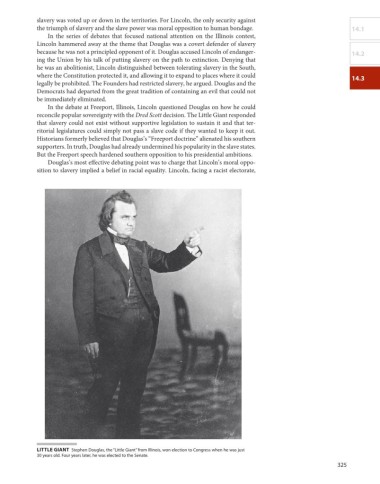
                    LittLe giANt  Stephen Douglas, the “Little Giant” from illinois, won election to Congress when he was just
                    30 years old. Four years later, he was elected to the Senate.
                                                                                                                       325

