


Page 371 - American Stories, A History of the United States
P. 371
In the North, the firing on Sumter evoked
            15.1                                                                    an outpouring of patriotism and dedication
                                                                                    to the Union. “It seems as if we were never
                                                                                    alive till now; never had a country till now,”
            15.2                                                                    wrote a New Yorker; and a Bostonian noted,
                                                                                    “I never before knew what a popular excite-
                                                                                    ment can be.” Stephen A. Douglas, Lincoln’s

            15.3                                                                    former political rival, pledged his full support
                                                                                    for the crusade against secession and literally
                                                                                    worked himself to death rallying midwestern
                                                                                    Democrats behind the government. By fir-
            15.4
                                                                                    ing on the flag, the Confederacy united the
                                                                                    North. Everyone assumed the war would be
                                                                                    short and not very bloody. Whether Unionist
                                                                                    fervor could be sustained through a long and
                                                                                    costly struggle remained to be seen.
                                                                                       The Confederacy, which now moved
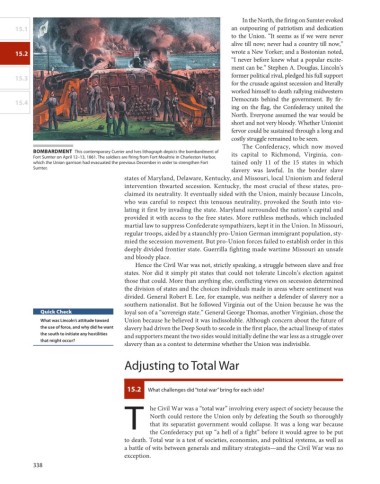
                  BoMBardMent  this contemporary Currier and Ives lithograph depicts the bombardment of   its capital to Richmond, Virginia, con-
                  Fort Sumter on April 12–13, 1861. the soldiers are firing from Fort Moultrie in Charleston Harbor,
                  which the Union garrison had evacuated the previous December in order to strengthen Fort   tained only 11 of the 15 states in which
                  Sumter.                                                           slavery  was  lawful.  In  the  border  slave
                                                states of Maryland, Delaware, Kentucky, and Missouri, local Unionism and federal
                                                intervention thwarted secession. Kentucky, the most crucial of these states, pro-
                                                claimed its neutrality. It eventually sided with the Union, mainly because Lincoln,
                                                who was careful to respect this tenuous neutrality, provoked the South into vio-
                                                lating it first by invading the state. Maryland surrounded the nation’s capital and
                                                provided it with access to the free states. More ruthless methods, which included
                                                martial law to suppress Confederate sympathizers, kept it in the Union. In Missouri,
                                                regular troops, aided by a staunchly pro-Union German immigrant population, sty-
                                                mied the secession movement. But pro-Union forces failed to establish order in this
                                                deeply divided frontier state. Guerrilla fighting made wartime Missouri an unsafe
                                                and bloody place.
                                                    Hence the Civil War was not, strictly speaking, a struggle between slave and free
                                                states. Nor did it simply pit states that could not tolerate Lincoln’s election against
                                                those that could. More than anything else, conflicting views on secession determined
                                                the division of states and the choices individuals made in areas where sentiment was
                                                divided. General Robert E. Lee, for example, was neither a defender of slavery nor a
                                                southern nationalist. But he followed Virginia out of the Union because he was the
                     Quick Check                loyal son of a “sovereign state.” General George Thomas, another Virginian, chose the
                     What was Lincoln’s attitude toward   Union because he believed it was indissoluble. Although concern about the future of
                     the use of force, and why did he want   slavery had driven the Deep South to secede in the first place, the actual lineup of states
                     the south to initiate any hostilities   and supporters meant the two sides would initially define the war less as a struggle over
                     that might occur?
                                                slavery than as a contest to determine whether the Union was indivisible.

                                                Adjusting to total War


                                                  15.2   What challenges did “total war” bring for each side?
                                                 t       he Civil War was a “total war” involving every aspect of society because the

                                                         North could restore the Union only by defeating the South so thoroughly
                                                         that its separatist government would collapse. It was a long war because
                                                         the Confederacy put up “a hell of a fight” before it would agree to be put
                                                to death. Total war is a test of societies, economies, and political systems, as well as
                                                a battle of wits between generals and military strategists—and the Civil War was no
                                                exception.
                  338

