


Page 375 - American Stories, A History of the United States
P. 375
15.1


            15.2


            15.3


            15.4


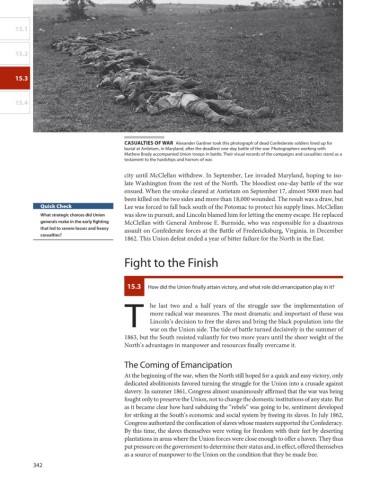
                                                casUaLties of war  Alexander Gardner took this photograph of dead Confederate soldiers lined up for
                                                burial at Antietam, in Maryland, after the deadliest one-day battle of the war. Photographers working with
                                                Mathew Brady accompanied Union troops in battle. their visual records of the campaigns and casualties stand as a
                                                testament to the hardships and horrors of war.


                                                city until McClellan withdrew. In September, Lee invaded Maryland, hoping to iso-
                                                late  Washington from the rest of the North. The bloodiest one-day battle of the war
                                                ensued. When the smoke cleared at Antietam on September 17, almost 5000 men had
                                                been killed on the two sides and more than 18,000 wounded. The result was a draw, but
                     Quick Check                Lee was forced to fall back south of the Potomac to protect his supply lines. McClellan
                     What strategic choices did Union   was slow in pursuit, and Lincoln blamed him for letting the enemy escape. He replaced
                     generals make in the early fighting   McClellan with General Ambrose E. Burnside, who was responsible for a disastrous
                     that led to severe losses and heavy   assault on Confederate forces at the Battle of Fredericksburg, Virginia, in December
                     casualties?
                                                1862. This Union defeat ended a year of bitter failure for the North in the East.


                                                Fight to the Finish


                                                  15.3   How did the Union finally attain victory, and what role did emancipation play in it?
                                                 t       he last two and a half years of the struggle saw the implementation of

                                                         more radical war measures. The most dramatic and important of these was
                                                           Lincoln’s decision to free the slaves and bring the black population into the
                                                         war on the Union side. The tide of battle turned decisively in the summer of
                                                1863, but the South resisted valiantly for two more years until the sheer weight of the
                                                North’s advantages in manpower and resources finally overcame it.


                                                the Coming of emancipation

                                                At the beginning of the war, when the North still hoped for a quick and easy victory, only
                                                dedicated abolitionists favored turning the struggle for the Union into a crusade against
                                                slavery. In summer 1861, Congress almost unanimously affirmed that the war was being
                                                fought only to preserve the Union, not to change the domestic institutions of any state. But
                                                as it became clear how hard subduing the “rebels” was going to be, sentiment developed
                                                for striking at the South’s economic and social system by freeing its slaves. In July 1862,
                                                Congress authorized the confiscation of slaves whose masters supported the Confederacy.
                                                By this time, the slaves themselves were voting for freedom with their feet by deserting
                                                plantations in areas where the Union forces were close enough to offer a haven. They thus
                                                put pressure on the government to determine their status and, in effect, offered themselves
                                                as a source of manpower to the Union on the condition that they be made free.
                  342

