


Page 381 - American Stories, A History of the United States
P. 381
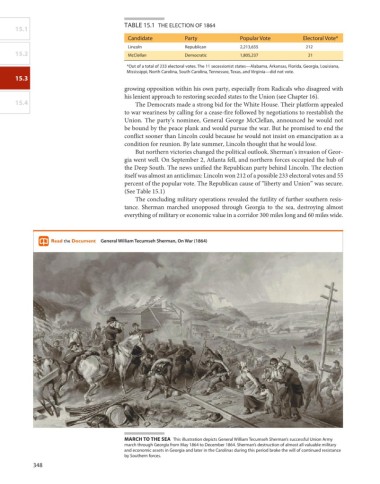
tABLe 15.1  tHe eLeCtION OF 1864
            15.1
                                                  Candidate         Party             Popular vote         electoral vote*
                                                  Lincoln           Republican        2,213,655             212
            15.2                                  McClellan         Democratic        1,805,237              21

                                                 *Out of a total of 233 electoral votes. the 11 secessionist states—Alabama, Arkansas, Florida, Georgia, Louisiana,
                                                 Mississippi, North Carolina, South Carolina, tennessee, texas, and virginia—did not vote.
            15.3
                                                growing opposition within his own party, especially from Radicals who disagreed with
                                                his lenient approach to restoring seceded states to the Union (see Chapter 16).
            15.4                                    The Democrats made a strong bid for the White House. Their platform appealed
                                                to war weariness by calling for a cease-fire followed by negotiations to reestablish the
                                                Union. The party’s nominee, General George McClellan, announced he would not
                                                be bound by the peace plank and would pursue the war. But he promised to end the
                                                conflict sooner than Lincoln could because he would not insist on emancipation as a
                                                condition for reunion. By late summer, Lincoln thought that he would lose.
                                                    But northern victories changed the political outlook. Sherman’s invasion of Geor-
                                                gia went well. On September 2, Atlanta fell, and northern forces occupied the hub of
                                                the Deep South. The news unified the Republican party behind Lincoln. The election
                                                itself was almost an anticlimax: Lincoln won 212 of a possible 233 electoral votes and 55
                                                percent of the popular vote. The Republican cause of “liberty and Union” was secure.
                                                (See Table 15.1)
                                                    The concluding military operations revealed the futility of further southern resis-
                                                tance. Sherman marched unopposed through Georgia to the sea, destroying almost
                                                everything of military or economic value in a corridor 300 miles long and 60 miles wide.


                          Read the Document  General William Tecumseh Sherman, On War (1864)


                                                March to the sea  this illustration depicts General William tecumseh Sherman’s successful Union Army
                                                march through Georgia from May 1864 to December 1864. Sherman’s destruction of almost all valuable military
                                                and economic assets in Georgia and later in the Carolinas during this period broke the will of continued resistance
                                                by Southern forces.
                  348

