


Page 477 - Business Principles and Management
P. 477
Unit 5


                                                           Businesses and individual investors with large sums of money fre-
                                                        quently invest in Treasury securities because they are practically risk
                                                        free and are easy to buy and sell. All Treasury securities are very liquid,
                                                        meaning they are easily traded even though they may not mature for
                                                        several years. Because the interest rates on securities fluctuate based
                                                        on demand and economic conditions, investors are willing to purchase
                                                        securities owned by other investors, usually at a discounted price,
                                                        with the hope of making a profit.
                                                           A Treasury bill, or T-bill, is a short-term security that pays the
                                                        lowest interest rates of the various Treasury instruments. T-bills are
                                                        sold in $1,000 multiples, but investors can purchase multiple amounts
                                                        up to a total of $5 million. The bills mature in 4, 13, or 26 weeks.
                                                   PHOTO: © GETTY IMAGES/PHOTODISC.  cial institutions, including banks, brokers, and dealers. They then resell
                                                        Treasury bills are normally purchased from the government by finan-

                                                        the T-bills to individual and business investors. T-bills are purchased at a
                                                        discount based on the interest rate of the security. For example, a
                                                        $1,000 bill may cost $960. When it matures, the owner is paid the full
                                                        $1,000. The $40 difference reflects a 4 percent interest rate.
                                                           A Treasury note is a medium-length security that is available in
                                                        $1,000 multiples and matures in 2, 3, 5, or 10 years. Treasury notes are
                                                        fixed-rate securities, meaning the interest rate remains the same through-
                                                        out the term of the note. Interest is paid every six months. When the note
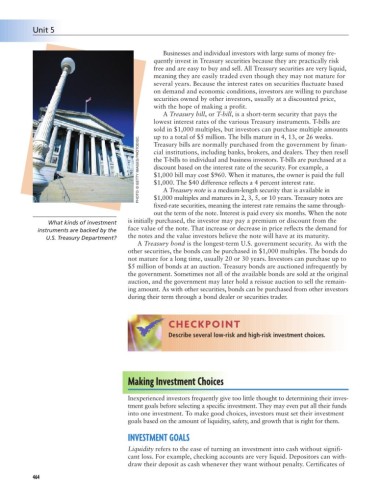
                       What kinds of investment  is initially purchased, the investor may pay a premium or discount from the
                   instruments are backed by the  face value of the note. That increase or decrease in price reflects the demand for
                      U.S. Treasury Department?  the notes and the value investors believe the note will have at its maturity.
                                                   A Treasury bond is the longest-term U.S. government security. As with the
                                                other securities, the bonds can be purchased in $1,000 multiples. The bonds do
                                                not mature for a long time, usually 20 or 30 years. Investors can purchase up to
                                                $5 million of bonds at an auction. Treasury bonds are auctioned infrequently by
                                                the government. Sometimes not all of the available bonds are sold at the original
                                                auction, and the government may later hold a reissue auction to sell the remain-
                                                ing amount. As with other securities, bonds can be purchased from other investors
                                                during their term through a bond dealer or securities trader.


                                                             CHECKPOINT
                                                             Describe several low-risk and high-risk investment choices.


                                                Making Investment Choices


                                                Inexperienced investors frequently give too little thought to determining their inves-
                                                tment goals before selecting a specific investment. They may even put all their funds
                                                into one investment. To make good choices, investors must set their investment
                                                goals based on the amount of liquidity, safety, and growth that is right for them.

                                                INVESTMENT GOALS

                                                Liquidity refers to the ease of turning an investment into cash without signifi-
                                                cant loss. For example, checking accounts are very liquid. Depositors can with-
                                                draw their deposit as cash whenever they want without penalty. Certificates of

                  464

