


Page 478 - Business Principles and Management
P. 478
Chapter 17 • Financial Services


                        deposit are less liquid. If depositors withdraw their money from a CD before
                        the end of its term, they have to pay a penalty, which may be substantial. If a  facts
                        small company, such as Kilgore Kitchens in the opening scenario, needs cash       &
                        regularly, it should choose more liquid investments. Kilgore’s owners might
                        choose to invest in money market accounts rather than mutual funds so they              figures
                        can get cash when they need it with a low risk of financial loss. On the other
                        hand, an established, profitable firm may have a steady source of cash from its
                        operations. Instead of needing cash soon, it may need to replace costly equip-  Just as the United States has
                        ment in five years, so it may choose to invest in less liquid but more profitable  the Dow Jones, NASDAQ, and
                        investments. Treasury notes and bills might be appropriate choices for this  Standard & Poor’s stock in-
                        firm. The different objectives of these two firms will determine, in part, the   dexes, other countries main-
                        investments they select.                                                 tain indexes to reflect the
                           A second investment goal is the degree of safety desired. In general, riskier in-  performance of key stocks
                        vestments have higher earning potential than do less risky investments. However,  important to their economies.
                        with those choices, investors are more likely to lose all or part of their invest-  Some examples are the Bovespa
                        ment. Some investors want maximum safety—they do not want to risk losing any  in Brazil, Hang Seng in Hong
                        of their money. To achieve a high degree of safety, they will likely have to accept  Kong, Nikkei 225 in Japan,
                        smaller earnings on the investment. Investment in savings accounts, money mar-  DAX in Germany, FTSE 100 in
                        ket accounts, and government securities should appeal to them because of the  the United Kingdom, and
                        low risk. Other investors like to take some risks for the opportunity to earn more  TA-100 in Israel.
                        money. These investors might prefer to buy stock in a rapidly growing corpora-
                        tion, in a developing country, or in a new Internet firm.
                           The third investment goal involves the trade-off between investment growth
                        and a stable income from the investment. Investors who do not need a steady
                        income from their investments and are willing to invest for long periods of time
                        will choose to invest in growth-oriented corporations. They hope to see their
                        investments grow at a faster rate than inflation. Investors who want to count on
                        a regular income might choose to invest in stocks or mutual funds with a history
                        of paying high dividends.
                           Most experienced investors also suggest another rule that pertains to safety:
                        “Don’t put all your eggs in one basket.” Investors should diversify, that is, spread
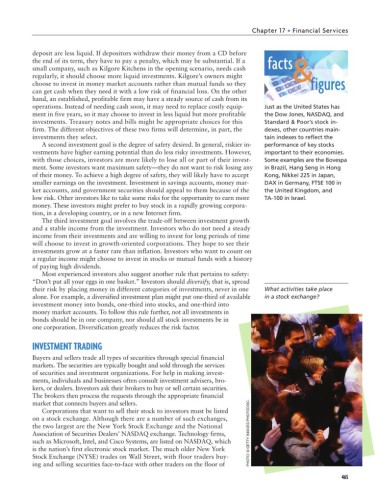
                        their risk by placing money in different categories of investments, never in one  What activities take place
                        alone. For example, a diversified investment plan might put one-third of available  in a stock exchange?
                        investment money into bonds, one-third into stocks, and one-third into
                        money market accounts. To follow this rule further, not all investments in
                        bonds should be in one company, nor should all stock investments be in
                        one corporation. Diversification greatly reduces the risk factor.

                        INVESTMENT TRADING

                        Buyers and sellers trade all types of securities through special financial
                        markets. The securities are typically bought and sold through the services
                        of securities and investment organizations. For help in making invest-
                        ments, individuals and businesses often consult investment advisers, bro-
                        kers, or dealers. Investors ask their brokers to buy or sell certain securities.
                        The brokers then process the requests through the appropriate financial
                        market that connects buyers and sellers.
                           Corporations that want to sell their stock to investors must be listed
                        on a stock exchange. Although there are a number of such exchanges,
                        the two largest are the New York Stock Exchange and the National
                        Association of Securities Dealers’ NASDAQ exchange. Technology firms,  PHOTO: © GETTY IMAGES/PHOTODISC.
                        such as Microsoft, Intel, and Cisco Systems, are listed on NASDAQ, which
                        is the nation’s first electronic stock market. The much older New York
                        Stock Exchange (NYSE) trades on Wall Street, with floor traders buy-
                        ing and selling securities face-to-face with other traders on the floor of

                                                                                                                         465

