


Page 504 - Business Principles and Management
P. 504
Chapter 18 • Credit and Insurance


                        Basic Insurance Concepts


                        Even with effective management, companies must purchase insurance to cover
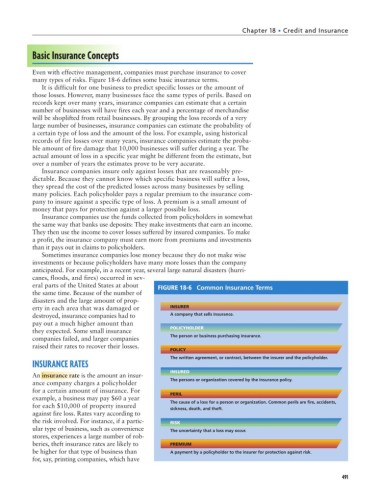
                        many types of risks. Figure 18-6 defines some basic insurance terms.
                           It is difficult for one business to predict specific losses or the amount of
                        those losses. However, many businesses face the same types of perils. Based on
                        records kept over many years, insurance companies can estimate that a certain
                        number of businesses will have fires each year and a percentage of merchandise
                        will be shoplifted from retail businesses. By grouping the loss records of a very
                        large number of businesses, insurance companies can estimate the probability of
                        a certain type of loss and the amount of the loss. For example, using historical
                        records of fire losses over many years, insurance companies estimate the proba-
                        ble amount of fire damage that 10,000 businesses will suffer during a year. The
                        actual amount of loss in a specific year might be different from the estimate, but
                        over a number of years the estimates prove to be very accurate.
                           Insurance companies insure only against losses that are reasonably pre-
                        dictable. Because they cannot know which specific business will suffer a loss,
                        they spread the cost of the predicted losses across many businesses by selling
                        many policies. Each policyholder pays a regular premium to the insurance com-
                        pany to insure against a specific type of loss. A premium is a small amount of
                        money that pays for protection against a larger possible loss.
                           Insurance companies use the funds collected from policyholders in somewhat
                        the same way that banks use deposits: They make investments that earn an income.
                        They then use the income to cover losses suffered by insured companies. To make
                        a profit, the insurance company must earn more from premiums and investments
                        than it pays out in claims to policyholders.
                           Sometimes insurance companies lose money because they do not make wise
                        investments or because policyholders have many more losses than the company
                        anticipated. For example, in a recent year, several large natural disasters (hurri-
                        canes, floods, and fires) occurred in sev-
                        eral parts of the United States at about  FIGURE 18-6 Common Insurance Terms
                        the same time. Because of the number of
                        disasters and the large amount of prop-
                        erty in each area that was damaged or      INSURER
                        destroyed, insurance companies had to      A company that sells insurance.
                        pay out a much higher amount than
                                                                   POLICYHOLDER
                        they expected. Some small insurance
                        companies failed, and larger companies     The person or business purchasing insurance.
                        raised their rates to recover their losses.
                                                                   POLICY
                                                                   The written agreement, or contract, between the insurer and the policyholder.
                        INSURANCE RATES
                                                                   INSURED
                        An insurance rate is the amount an insur-
                                                                   The persons or organization covered by the insurance policy.
                        ance company charges a policyholder
                        for a certain amount of insurance. For
                                                                   PERIL
                        example, a business may pay $60 a year
                                                                   The cause of a loss for a person or organization. Common perils are fire, accidents,
                        for each $10,000 of property insured
                                                                   sickness, death, and theft.
                        against fire loss. Rates vary according to
                        the risk involved. For instance, if a partic-  RISK
                        ular type of business, such as convenience  The uncertainty that a loss may occur.
                        stores, experiences a large number of rob-
                        beries, theft insurance rates are likely to  PREMIUM
                        be higher for that type of business than   A payment by a policyholder to the insurer for protection against risk.
                        for, say, printing companies, which have


                                                                                                                          491

