


Page 631 - Business Principles and Management
P. 631
Unit 7


                                                budget. The level of wages and benefits, especially when compared to that of
                                                competitors, helps to determine who will apply for job openings and whether
                                                they are likely to make a long-term commitment to the company or will be look-
                                                ing for higher-paying jobs. When performing the wages-and-benefits function,
                                                human resources employees plan and manage the financial and nonfinancial
                                                rewards available to employees.
                                                   Wages and benefits must be carefully controlled. Employee productivity (the
                                                amount of work accomplished) compared to the pay and benefits will determine
                                                whether the company can be profitable or not. It is important that employees
                                                view the system for determining pay as fair and that there is a reasonable relation-
                                                ship between the amount paid to an employee and the value of that employee’s
                                                work to the company. Human resources is typically responsible for developing a
                                                pay system that classifies jobs according to levels and pay ranges. When a person
                                                is hired, promoted, or given a pay increase, human resources performs or moni-
                                                tors the procedures to ensure that the employee gets paid the correct amount.
                                                   Companies offer benefits to their employees in addition to wages. Some ben-
                                                efits, such as Social Security and Medicare, are required by law. Others, such as
                                                insurance and vacations, are not legally required, but many companies provide
                                                them. Often benefit plans are different for full-time than for part-time employees or
                                                are based on the length of time the employee has worked for the company. People
                                                who work in human resources study what benefits can be offered, determine the
                                                current and future costs of each type of benefit, and help management develop the
                                                benefits plan. They also provide information to employees about each type of bene-
                                                fit and make sure that employees recognize the value of the benefits to them.
                                                   Some companies offer employees choices of benefits, so helping employees
                                                make the best decisions and keeping track of each person’s choices can be quite
                                                complicated. Once employees make their decisions, human resources employees
                                                complete the necessary paperwork or enter the data into the company’s com-
                                                puter system. Each benefit program must be monitored to control costs and to
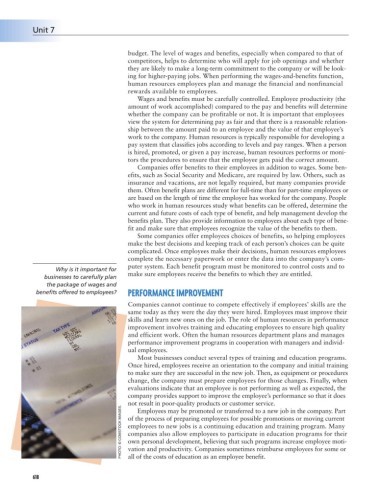
                         Why is it important for
                     businesses to carefully plan  make sure employees receive the benefits to which they are entitled.
                      the package of wages and
                   benefits offered to employees?  PERFORMANCE IMPROVEMENT
                                                Companies cannot continue to compete effectively if employees’ skills are the
                                                same today as they were the day they were hired. Employees must improve their
                                                skills and learn new ones on the job. The role of human resources in performance
                                                improvement involves training and educating employees to ensure high quality
                                                and efficient work. Often the human resources department plans and manages
                                                performance improvement programs in cooperation with managers and individ-
                                                ual employees.
                                                   Most businesses conduct several types of training and education programs.
                                                Once hired, employees receive an orientation to the company and initial training
                                                to make sure they are successful in the new job. Then, as equipment or procedures
                                                change, the company must prepare employees for those changes. Finally, when
                                                evaluations indicate that an employee is not performing as well as expected, the
                                                company provides support to improve the employee’s performance so that it does
                                                not result in poor-quality products or customer service.
                                              PHOTO: © COMSTOCK IMAGES.  of the process of preparing employees for possible promotions or moving current
                                                   Employees may be promoted or transferred to a new job in the company. Part
                                                employees to new jobs is a continuing education and training program. Many
                                                companies also allow employees to participate in education programs for their
                                                own personal development, believing that such programs increase employee moti-
                                                vation and productivity. Companies sometimes reimburse employees for some or


                  618                           all of the costs of education as an employee benefit.

