


Page 633 - Business Principles and Management
P. 633
Unit 7


                                                   Most human resources departments provide regular safety training, place
                                                safety posters and materials in the workplace to remind workers to follow safety
                                                procedures, and monitor procedures to identify and correct possible safety
                                                problems. They also collect and report data on work-related injuries and
                                                illnesses to be sure the company and employees are well informed about
                                                the level of safety in the company and in each department. Companies often
                                                reward work units that operate for a specific amount of time without a job-
                                                related injury.
                                                   Companies sometimes promote good health by maintaining a smoke-free envi-
                                                ronment and offering help for employees to stop smoking through education pro-
                                              PHOTO: © GETTY IMAGES/PHOTODISC.  and cut insurance costs, many companies organize wellness and fitness programs,
                                                grams, support groups, and even financial bonuses. To reduce employee absences

                                                build and staff fitness centers, and pay for employees to enroll in health education
                                                classes.


                                                PERFORMANCE MANAGEMENT
                                                Managers regularly evaluate their employees’ performance to determine how
                                                well it is meeting expectations. They identify employees’ strengths and reward
                                                them for superior performance. If they discover performance problems, they
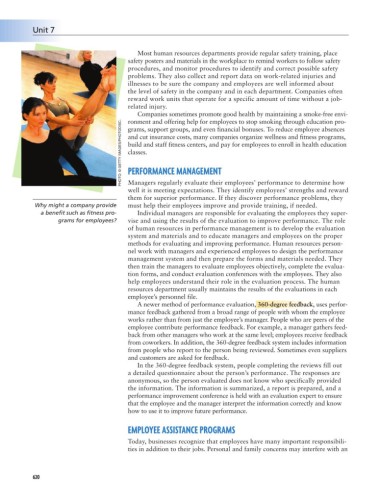
                  Why might a company provide   must help their employees improve and provide training, if needed.
                    a benefit such as fitness pro-  Individual managers are responsible for evaluating the employees they super-
                          grams for employees?    vise and using the results of the evaluation to improve performance. The role
                                                of human resources in performance management is to develop the evaluation
                                                system and materials and to educate managers and employees on the proper
                                                methods for evaluating and improving performance. Human resources person-
                                                nel work with managers and experienced employees to design the performance
                                                management system and then prepare the forms and materials needed. They
                                                then train the managers to evaluate employees objectively, complete the evalua-
                                                tion forms, and conduct evaluation conferences with the employees. They also
                                                help employees understand their role in the evaluation process. The human
                                                resources department usually maintains the results of the evaluations in each
                                                employee’s personnel file.
                                                   A newer method of performance evaluation, 360-degree feedback, uses perfor-
                                                mance feedback gathered from a broad range of people with whom the employee
                                                works rather than from just the employee’s manager. People who are peers of the
                                                employee contribute performance feedback. For example, a manager gathers feed-
                                                back from other managers who work at the same level; employees receive feedback
                                                from coworkers. In addition, the 360-degree feedback system includes information
                                                from people who report to the person being reviewed. Sometimes even suppliers
                                                and customers are asked for feedback.
                                                   In the 360-degree feedback system, people completing the reviews fill out
                                                a detailed questionnaire about the person’s performance. The responses are
                                                anonymous, so the person evaluated does not know who specifically provided
                                                the information. The information is summarized, a report is prepared, and a
                                                performance improvement conference is held with an evaluation expert to ensure
                                                that the employee and the manager interpret the information correctly and know
                                                how to use it to improve future performance.


                                                EMPLOYEE ASSISTANCE PROGRAMS
                                                Today, businesses recognize that employees have many important responsibili-
                                                ties in addition to their jobs. Personal and family concerns may interfere with an


                  620

