


Page 669 - Business Principles and Management
P. 669
Unit 7


                                                equipment to employees who will use it. Informal training also includes self-study
                                                by individual employees and coaching provided by a supervisor or mentor.
                                                   Studies estimate that U.S. companies spend $50–60 billion each year on
                                                formal training programs. Informal training may cost businesses as much as an
                                                additional $200 billion each year. Beyond the costs of training, many companies
                                                pay some or all of the costs of college courses that employees take as part of
                                                preparing for promotions and career advancement or as an employee benefit.
                                                The large allocation of money for training and development can be justified if
                                                the result is employees who are able to perform more and higher-quality work.

                                                EFFECTIVE TRAINING
                                                As companies recognize the value of training, they are working to develop more
                                                effective training procedures. On the average, companies spend several hundred
                                                dollars on every employee each year for training. Therefore, they want to be sure
                                                the training is effective at improving employees’ performance. Trainers use many
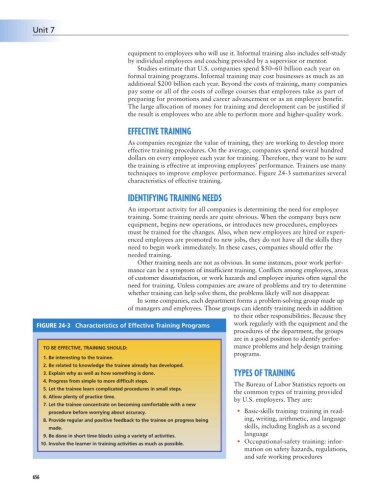
                                                techniques to improve employee performance. Figure 24-3 summarizes several
                                                characteristics of effective training.

                                                IDENTIFYING TRAINING NEEDS
                                                An important activity for all companies is determining the need for employee
                                                training. Some training needs are quite obvious. When the company buys new
                                                equipment, begins new operations, or introduces new procedures, employees
                                                must be trained for the changes. Also, when new employees are hired or experi-
                                                enced employees are promoted to new jobs, they do not have all the skills they
                                                need to begin work immediately. In these cases, companies should offer the
                                                needed training.
                                                   Other training needs are not as obvious. In some instances, poor work perfor-
                                                mance can be a symptom of insufficient training. Conflicts among employees, areas
                                                of customer dissatisfaction, or work hazards and employee injuries often signal the
                                                need for training. Unless companies are aware of problems and try to determine
                                                whether training can help solve them, the problems likely will not disappear.
                                                   In some companies, each department forms a problem-solving group made up
                                                of managers and employees. Those groups can identify training needs in addition
                                                                                 to their other responsibilities. Because they
                   FIGURE 24-3 Characteristics of Effective Training Programs    work regularly with the equipment and the
                                                                                 procedures of the department, the groups
                                                                                 are in a good position to identify perfor-
                      TO BE EFFECTIVE, TRAINING SHOULD:                          mance problems and help design training
                                                                                 programs.
                      1. Be interesting to the trainee.
                      2. Be related to knowledge the trainee already has developed.
                      3. Explain why as well as how something is done.           TYPES OF TRAINING
                      4. Progress from simple to more difficult steps.
                                                                                 The Bureau of Labor Statistics reports on
                      5. Let the trainee learn complicated procedures in small steps.
                                                                                 the common types of training provided
                      6. Allow plenty of practice time.
                                                                                 by U.S. employers. They are:
                      7. Let the trainee concentrate on becoming comfortable with a new
                          procedure before worrying about accuracy.               • Basic-skills training: training in read-
                      8. Provide regular and positive feedback to the trainee on progress being  ing, writing, arithmetic, and language
                                                                                    skills, including English as a second
                          made.
                                                                                    language
                      9. Be done in short time blocks using a variety of activities.
                                                                                  • Occupational-safety training: infor-
                    10. Involve the learner in training activities as much as possible.
                                                                                    mation on safety hazards, regulations,
                                                                                    and safe working procedures

                  656

