


Page 1011 - Basic Electrical Engineering
P. 1011
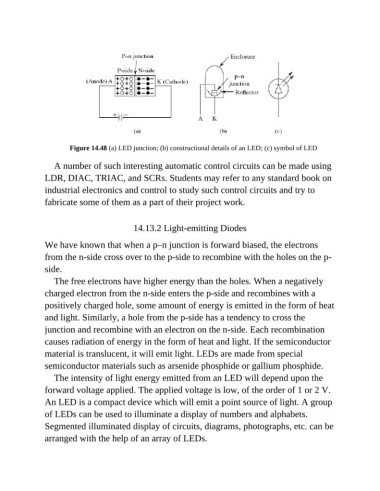
Figure 14.48 (a) LED junction; (b) constructional details of an LED; (c) symbol of LED


                  A number of such interesting automatic control circuits can be made using
               LDR, DIAC, TRIAC, and SCRs. Students may refer to any standard book on

               industrial electronics and control to study such control circuits and try to
               fabricate some of them as a part of their project work.


                                            14.13.2 Light-emitting Diodes


               We have known that when a p–n junction is forward biased, the electrons
               from the n-side cross over to the p-side to recombine with the holes on the p-

               side.
                  The free electrons have higher energy than the holes. When a negatively
               charged electron from the n-side enters the p-side and recombines with a

               positively charged hole, some amount of energy is emitted in the form of heat
               and light. Similarly, a hole from the p-side has a tendency to cross the

               junction and recombine with an electron on the n-side. Each recombination
               causes radiation of energy in the form of heat and light. If the semiconductor

               material is translucent, it will emit light. LEDs are made from special
               semiconductor materials such as arsenide phosphide or gallium phosphide.

                  The intensity of light energy emitted from an LED will depend upon the
               forward voltage applied. The applied voltage is low, of the order of 1 or 2 V.
               An LED is a compact device which will emit a point source of light. A group

               of LEDs can be used to illuminate a display of numbers and alphabets.
               Segmented illuminated display of circuits, diagrams, photographs, etc. can be

               arranged with the help of an array of LEDs.

