


Page 1009 - Basic Electrical Engineering
P. 1009
called light dependent resistors (LDRs). Widely used optoelectronic devices
               are discussed in this section.


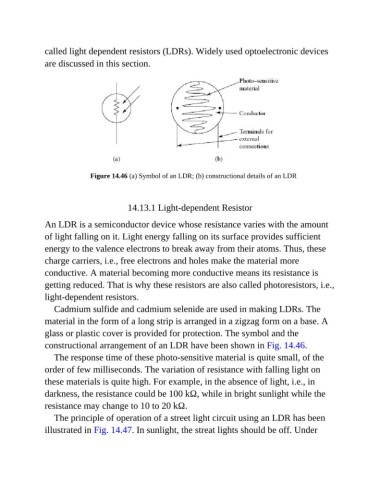
                              Figure 14.46 (a) Symbol of an LDR; (b) constructional details of an LDR


                                          14.13.1 Light-dependent Resistor

               An LDR is a semiconductor device whose resistance varies with the amount

               of light falling on it. Light energy falling on its surface provides sufficient
               energy to the valence electrons to break away from their atoms. Thus, these

               charge carriers, i.e., free electrons and holes make the material more
               conductive. A material becoming more conductive means its resistance is

               getting reduced. That is why these resistors are also called photoresistors, i.e.,
               light-dependent resistors.

                  Cadmium sulfide and cadmium selenide are used in making LDRs. The
               material in the form of a long strip is arranged in a zigzag form on a base. A
               glass or plastic cover is provided for protection. The symbol and the

               constructional arrangement of an LDR have been shown in Fig. 14.46.
                  The response time of these photo-sensitive material is quite small, of the

               order of few milliseconds. The variation of resistance with falling light on
               these materials is quite high. For example, in the absence of light, i.e., in

               darkness, the resistance could be 100 kΩ, while in bright sunlight while the
               resistance may change to 10 to 20 kΩ.

                  The principle of operation of a street light circuit using an LDR has been
               illustrated in Fig. 14.47. In sunlight, the streat lights should be off. Under

