


Page 1006 - Basic Electrical Engineering
P. 1006
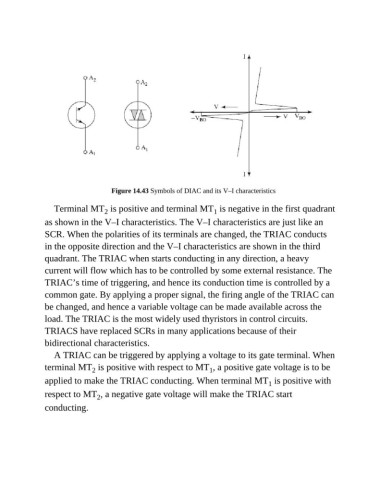
Figure 14.43 Symbols of DIAC and its V–I characteristics

                  Terminal MT  is positive and terminal MT  is negative in the first quadrant
                                   2
                                                                      1
               as shown in the V–I characteristics. The V–I characteristics are just like an
               SCR. When the polarities of its terminals are changed, the TRIAC conducts

               in the opposite direction and the V–I characteristics are shown in the third
               quadrant. The TRIAC when starts conducting in any direction, a heavy

               current will flow which has to be controlled by some external resistance. The
               TRIAC’s time of triggering, and hence its conduction time is controlled by a

               common gate. By applying a proper signal, the firing angle of the TRIAC can
               be changed, and hence a variable voltage can be made available across the

               load. The TRIAC is the most widely used thyristors in control circuits.
               TRIACS have replaced SCRs in many applications because of their
               bidirectional characteristics.

                  A TRIAC can be triggered by applying a voltage to its gate terminal. When
               terminal MT  is positive with respect to MT , a positive gate voltage is to be
                                                                    1
                               2
               applied to make the TRIAC conducting. When terminal MT  is positive with
                                                                                       1
               respect to MT , a negative gate voltage will make the TRIAC start
                                2
               conducting.

