


Page 1069 - Basic Electrical Engineering
P. 1069
Third column, 1 + 0 = 1, 1 + 1 = 10, place 0 and carry 1
               Fourth column, 1 + 0 = 1, place 1 and carry 0
               Fifth column, 1 + 0 = 1, place 1


                                               16.2.6 Binary Subtraction

               The following rules are used for binary subtraction


                   i.  0 – 0 = 0
                  ii.  1 – 0 = 1
                  iii.  1 – 1 = 0
                  iv.  10 – 1 = 1     (decimal equivalent of 10 is binary 2)


               Examples

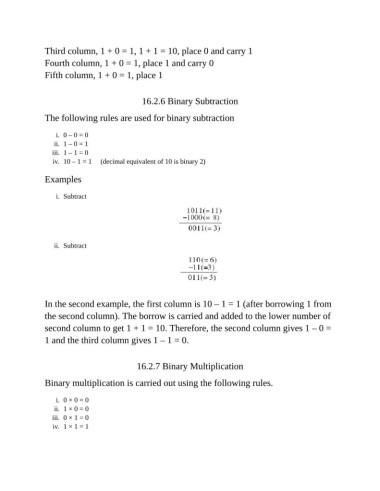
                   i.  Subtract


                  ii.  Subtract


               In the second example, the first column is 10 – 1 = 1 (after borrowing 1 from
               the second column). The borrow is carried and added to the lower number of

               second column to get 1 + 1 = 10. Therefore, the second column gives 1 – 0 =
               1 and the third column gives 1 – 1 = 0.


                                             16.2.7 Binary Multiplication

               Binary multiplication is carried out using the following rules.


                   i.  0 × 0 = 0
                  ii.  1 × 0 = 0
                  iii.  0 × 1 = 0
                  iv.  1 × 1 = 1

