


Page 1072 - Basic Electrical Engineering
P. 1072
= 256 + 8 + 5 + 0.25
                        = 269.25
                                   2       1               −1       −2
                  ii.  732.14 = 7 × 8  + 3 × 8  + 2 × 8° + 1 × 8   + 4 × 8
                        = 448 + 24 + 2 + 0.125 + 0.0625
                        = 474.1875


                                          16.4 HEXADECIMAL NUMBER SYSTEM
               In hexadecimal system we use 16 symbols, viz 0 to 9 and the capital letters A

               B C D E F for 10 to 15. Hence, the hexadecimal number system uses a base
               of 16.

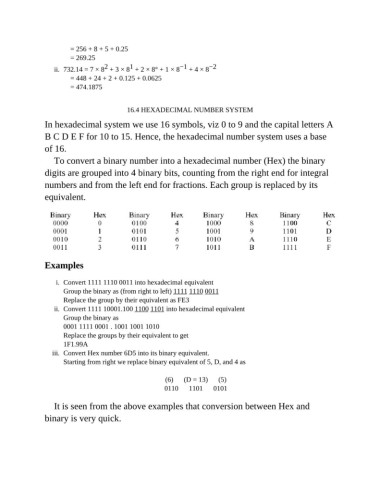
                  To convert a binary number into a hexadecimal number (Hex) the binary
               digits are grouped into 4 binary bits, counting from the right end for integral

               numbers and from the left end for fractions. Each group is replaced by its
               equivalent.


               Examples

                   i.  Convert 1111 1110 0011 into hexadecimal equivalent
                     Group the binary as (from right to left) 1111 1110 0011
                     Replace the group by their equivalent as FE3
                  ii.  Convert 1111 10001.100 1100 1101 into hexadecimal equivalent
                     Group the binary as
                     0001 1111 0001 . 1001 1001 1010
                     Replace the groups by their equivalent to get
                     1F1.99A
                  iii.  Convert Hex number 6D5 into its binary equivalent.
                     Starting from right we replace binary equivalent of 5, D, and 4 as

                                                      (6)      (D = 13)      (5)
                                                      0110      1101      0101

                  It is seen from the above examples that conversion between Hex and

               binary is very quick.

