


Page 488 - Basic Electrical Engineering
P. 488
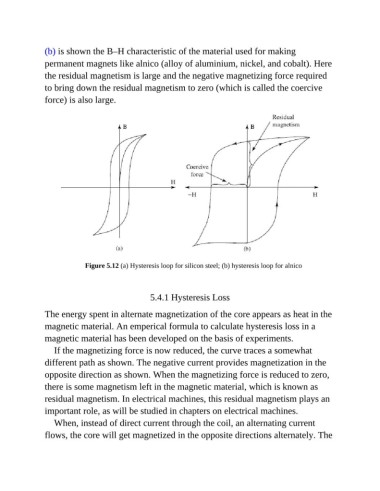
(b) is shown the B–H characteristic of the material used for making
               permanent magnets like alnico (alloy of aluminium, nickel, and cobalt). Here
               the residual magnetism is large and the negative magnetizing force required

               to bring down the residual magnetism to zero (which is called the coercive
               force) is also large.


                            Figure 5.12 (a) Hysteresis loop for silicon steel; (b) hysteresis loop for alnico


                                                 5.4.1 Hysteresis Loss


               The energy spent in alternate magnetization of the core appears as heat in the
               magnetic material. An emperical formula to calculate hysteresis loss in a

               magnetic material has been developed on the basis of experiments.
                  If the magnetizing force is now reduced, the curve traces a somewhat
               different path as shown. The negative current provides magnetization in the

               opposite direction as shown. When the magnetizing force is reduced to zero,
               there is some magnetism left in the magnetic material, which is known as

               residual magnetism. In electrical machines, this residual magnetism plays an
               important role, as will be studied in chapters on electrical machines.

                  When, instead of direct current through the coil, an alternating current
               flows, the core will get magnetized in the opposite directions alternately. The

